

After playing the live instrumentals that bring a song to life, you receive your one-time fee, leave the studio, and your relationship with the record ends there. The song goes on to climb charts, travel across borders, and generate significant revenue, but none of that reaches you. Sound familiar?
This is the financial reality for the vast majority of session musicians in Nigeria. Traditionally, session work has been structured as “work for hire,” where creative contribution is exchanged for immediate payment, with little or no participation in the long-term value of the song.
But that does not have to be your story.
The rise of digital distribution has expanded the revenue pathways attached to a single piece of music. Today, a song can generate income across streaming platforms, performance rights, sync placements, and other channels. For African session musicians and instrumentalists, this creates a real opportunity to earn recurring income, even after the studio session has ended.
However, access to these revenue streams is rarely automatic. It begins with awareness. You need to understand how value is created, tracked, and distributed within the music ecosystem. With that knowledge, you are in a stronger position to properly document your contributions and negotiate rights that reflect your role in the creative process.
Session musicians who understand how value flows in the music business, and how their contributions fit into that structure, are better positioned to move beyond one-time fees and begin participating in the long-term earnings of the music they help create.
What is a Session Musician?
A session musician is a professional performer hired to contribute to a recording or live event. They may be instrumentalists, vocalists, or backing musicians, brought in to deliver a specific musical element for an artist, producer, or label. Their role is typically project-based, with a clear scope of work and defined expectations.
In Nigeria, session musicians sit at the heart of the music production process. Whenever a track requires live instrumentation, textured arrangements, or additional vocal layers, they are called in to execute this.
Their work spans a wide range of settings, including studio recordings for commercial releases, live concerts and touring, film and television scoring, advertising jingles and branded content, church and private event performances, and remote sessions for international projects.
At the professional level, session musicians are specialists. They are valued for technical accuracy, speed, and their ability to interpret creative direction with minimal friction. In many cases, their contribution is the difference between a rough idea and a polished, commercially viable record.
How Much Does a Session Musician Get Paid in Nigeria?
The dominant payment model for session musicians in Nigeria is a flat fee tied to time spent on a project. This fee can vary widely. A session for an independent artist may pay modestly, while a commercial jingle for a major brand or a film scoring session can command a significantly higher rate.
There is no standardised industry pricing structure. Compensation is typically negotiated informally, shaped by relationships, reputation, bargaining power, and, in many cases, the urgency of the project.
However, the more critical issue is not the variability in fees. It is the fact that, in most cases, the fee marks the end of the financial relationship. Once the session musician leaves the studio, their economic connection to the recording effectively stops. If the song goes on to become commercially successful, generates sync income, earns publishing royalties, or is licensed for campaigns, the session musician does not share in that downstream value.
So why does this persist?
It comes down to a set of structural gaps:
- No split sheets: Many recording sessions take place without any written record of who contributed what or how rights should be allocated.
- Work-for-hire framing: Session musicians are often engaged on terms, whether explicitly stated or implied, that transfer any ownership interest in the recording to the artist or label in exchange for the session fee.
- No publishing registration: Even where a musician may have a legitimate claim to a share of publishing, it often goes unregistered, meaning any royalties that accrue are never collected.
- Limited awareness: Many African session musicians are not fully informed about the rights they can negotiate or how royalty and publishing systems operate in practice.
These factors reinforce one another. The result is a system where session musicians contribute to recordings that continue to generate value over time, yet remain excluded from that value once the initial fee has been paid.
What Session Musicians and Instrumentalists Should Do After a Gig to Secure Their Royalties
Moving from flat fees to recurring income is possible, but it requires a structured and deliberate approach. Session musicians who participate in the long-term value of the music they help create do so because they treat every engagement as a business transaction, not just a performance.
In practice, securing royalties is not one single action but a sequence of steps that begins before the session and continues even after the recording is complete.
Here is how it works:
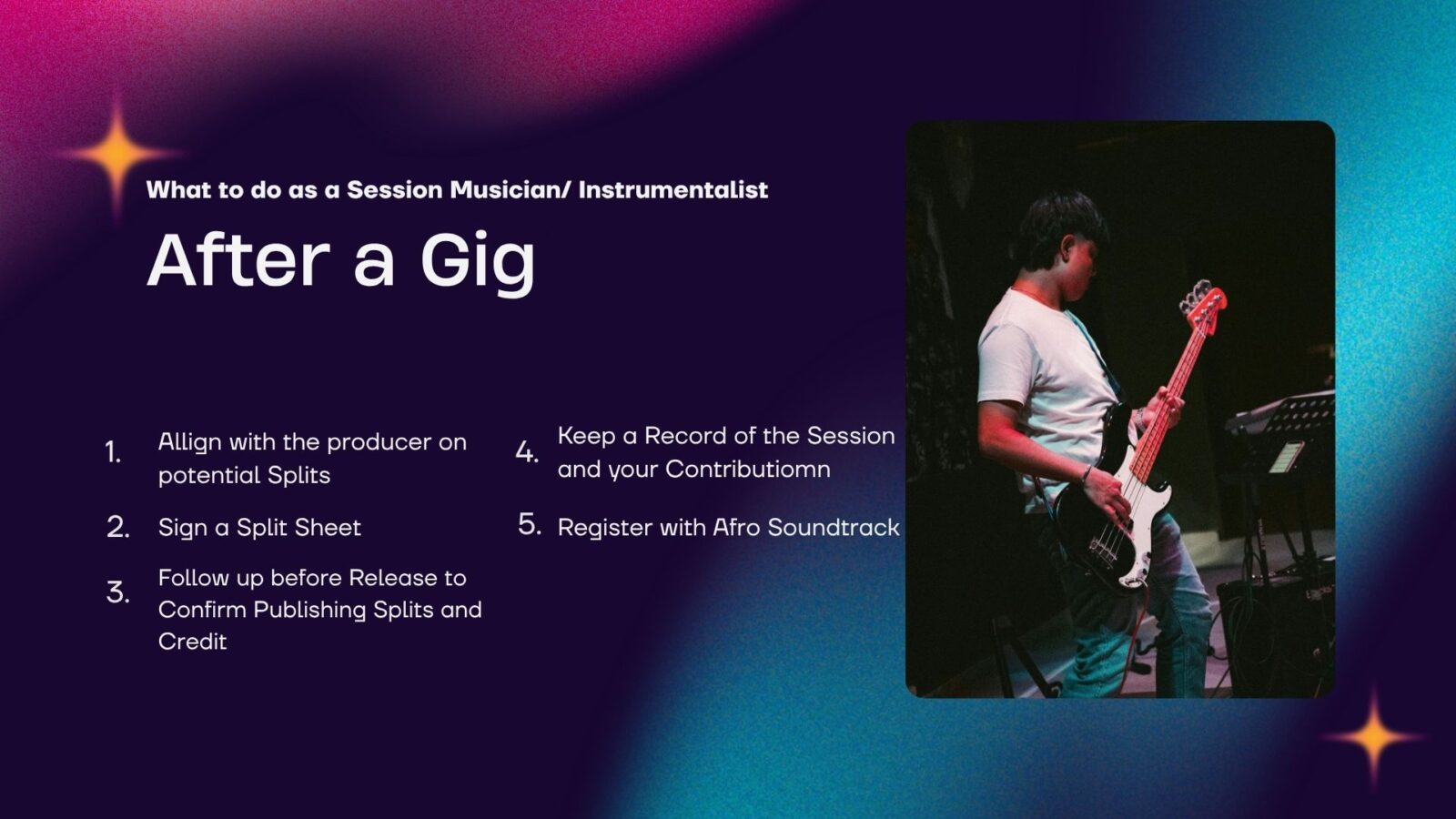
- Align with the Producer on potential Splits
It is important that you and the producer agree early on any potential splits attributable to your contribution. Clarity must be sought to ensure everyone is on the same page regarding how the work will be credited and shared.
- Sign a Split Sheet
Once contributions have been made, the next step is to formally document them.
A split sheet records who contributed to the song and the percentage of rights allocated to each person. It should be agreed upon and signed by all relevant parties immediately after the session, while the details are still clear and undisputed.
Without a split sheet, there is no formal record of your contribution or entitlement. In practice, this means you have little basis to claim royalties later, even if your input was significant.
To make this easier, you can use a standard split sheet template, such as the one provided by Afro Soundtrack, for every session.
- Follow up before release to confirm publishing splits and credits
After the session, but before the song is released, it is important to follow up with the producer, artist, or label to ensure that your contribution has been properly captured in the final credits and publishing splits.
This is where many session musicians lose out. Assumptions are made, metadata is entered incorrectly, or contributions are omitted entirely.
Confirming your splits and credits before release ensures that the information being submitted to distributors, publishers, and collecting societies accurately reflects your role.
- Keep a record of the session and your contribution
Alongside formal agreements, you should maintain your own documentation for every project.
This includes the project title, artist, producer, studio, date, and a clear description of what you contributed. Over time, this record becomes essential for verifying credits, supporting royalty claims, and demonstrating your track record as a professional.
- Register with Afro Soundtrack to access your royalties
This is the step that activates your earnings. Without registration, even properly agreed and documented rights may not translate into actual royalty payments.
Once your contributions and splits have been confirmed, they must be entered into recognised publishing systems in order to be tracked and monetised. This is what allows royalties from streaming, performance, and licensing to be identified and paid out correctly.
Afro Soundtrack supports this process by administering publishing registrations and facilitating royalty collection on behalf of music creators. This ensures that your contributions do not stop at the studio, but are carried through into the systems where long-term value is tracked and paid.
What Afro Soundtrack Does for Session Musicians and Instrumentalists
For most session musicians and instrumentalists, one of the most pressing challenges is the structural gap between creative contribution and the systems that track and reward long-term value.
Even where rights exist in principle, they are often lost in practice due to weak documentation, inconsistent registration, and limited access to publishing infrastructure. In many cases, there is also a fundamental lack of clarity about what these systems actually look like or how they function.
As a result, session gigs are often treated as isolated transactions, a one-time payment for time spent in the studio, with little expectation of anything beyond immediate compensation. Over time, this mindset reinforces a cycle where valuable creative input is exchanged for short-term fees, while long-term income from the same work flows elsewhere.
But that cycle is not inevitable. Afro Soundtrack exists to close that gap by providing the structure, systems, and support needed to ensure that creative contributions are properly registered and positioned to generate long-term value.
Afro Soundtrack is a music publishing and licensing administration platform built to help African music creators translate creative contributions into properly documented and trackable rights within global music systems. For African session musicians, Afro Soundtrack serves as the bridge between a one-time performance and a contribution that becomes part of a recognised, income-generating catalogue.
In practical terms, Afro Soundtrack supports this process through:
i. Publishing Registration and Administration
Afro Soundtrack supports the registration of eligible works and contributions, ensuring that rights tied to compositions and recordings are properly recorded and tracked within recognised publishing systems.
ii. Royalty Collection and Distribution
Where rights are correctly established and registered, Afro Soundtrack supports the collection and administration of publishing-related royalties, including performance and mechanical royalties generated through digital usage and other licensed exploitation of musical works.
iii. Licensing and Sync Opportunities
Afro Soundtrack helps position catalogued works for licensing opportunities across film, television, advertising, and digital media, where applicable, expanding the commercial lifespan of recorded music.
iv. Rights Education and Industry Guidance
Beyond publishing administration, Afro Soundtrack provides guidance on how music rights work in practice, helping session musicians and African music creators understand how to document contributions, structure engagements, and navigate the technical requirements of rights registration and metadata management.
Turning Your Gigs into Royalties as a Session Musician or Instrumentalist
The Nigerian music industry is expanding at a pace that is creating real opportunities for skilled musicians. Afrobeats continues to attract international investment and licensing interest, while Nollywood’s growing collaboration with global partners is increasing demand for original scoring and sync placements.
Gospel music, one of Nigeria’s most commercially active spaces, is also building a global audience supported by more structured publishing and distribution systems.
For session musicians and instrumentalists, this growth means that gigs are no longer just one-off opportunities to get paid and move on. Each gig is a potential entry point into a recording that can generate value over time.
Those who understand how to position themselves within this system stand to participate in that value. Those who continue to treat gigs as purely informal, fee-based engagements risk remaining outside the long-term revenue their work helps create.
You must remember that Session work is a creative contribution to a commercial asset that can generate value over time, and, whether that asset pays you once or continues to pay you over time depends on how well your contribution is documented, agreed, and registered at the point of creation.
If you are a session musician ready to move beyond one-time session fees, Afro Soundtrack provides a structured pathway to register, protect, and monetise your contributions. Sign up with Afro Soundtrack today.
Session Musicians and Royalties FAQs: Gigs, Split Sheets, and Earnings Explained
- Do session musicians earn royalties?
Yes. Session musicians can earn royalties if their contribution is recognised, credited, and properly registered within publishing systems. Without documentation and registration, they typically only receive a one-time session fee. Afro Soundtrack collects royalties for session musicians and instrumentalists in Nigeria and across Africa by supporting publishing registration and royalty distribution.
- What is the difference between a session fee and royalties?
A session fee is a one-time payment for performing on a gig. Royalties are recurring payments earned when music is used commercially.
- When should splits be agreed in a gig?
Splits should be agreed before or during the recording gig, not after.
- Why are split sheets important?
They serve as proof of contribution and determine royalty ownership and entitlement.
- Why don’t most session musicians earn royalties?
Most do not earn royalties because their contributions are not properly documented, credited, or registered.
- How can session musicians earn recurring income?
By agreeing on splits, signing split sheets, documenting gigs, registering works and signing up with Afro Soundtrack.
- When should a song be registered?
A song should be registered before or immediately after release to ensure accurate crediting and royalty tracking.
- Can Afro Soundtrack help session musicians collect royalties?
Yes. Afro Soundtrack supports the registration, administration, and collection of royalties for eligible music contributors.