
You edit your video, you choose the perfect song, you post it on Instagram, TikTok, Facebook or YouTube. And then, without warning, the audio disappears. The video is still there but the sound is gone. This happens to creators every single day, across every genre and every market and most of them don’t know why.
The answer comes down to how music rights, licensing agreements, and royalty systems work behind the scenes. Understanding that system is the first step to protecting your content and making sure your music earns what it deserves.
For African music creators specifically, social media platforms have become some of the most powerful discovery and monetisation tools in the industry. A single viral sound can generate millions of views, spark global trends and open up new revenue streams. But too many artists are still losing that income because their rights are not registered correctly, or their royalties are not being collected at all.
At Afro Soundtrack, this is exactly what we help African music creators fix. From rights registration to royalty collection, we ensure your music is positioned to earn wherever it is being used.
Here is everything you need to know.
Why Does Instagram or Facebook Mute My Video?
The answer is almost always copyright.
Every song is owned by someone, and social media platforms cannot legally distribute music without licensing agreements in place. When a video contains music that falls outside those agreements, platforms typically mute, block or remove the audio automatically.
Common Reasons Your Audio Gets Muted or Removed
- The song is not licensed for use in your region.
- You are using a business account with restricted music access.
- The licensing agreement between the platform and the rights holder has expired.
- Ownership of the song is under dispute.
- The platform cannot verify who owns the rights.
Sometimes the issue has nothing to do with anything you did. For example, Instagram and TikTok regularly license music from labels and distributors. If one of those agreements expires, content that previously used the music legally can suddenly lose audio.
This happened in 2024 when Universal Music Group removed its catalogue from TikTok following a dispute over royalty payments and artist protections. Overnight, videos featuring music from artists such as Taylor Swift, Drake and Rihanna were muted across the platform.
Why Did I Get a Copyright Claim on My Own Song?
This one surprises a lot of independent artists. You wrote the song, you recorded it, you own it, and yet you post it and get a copyright claim. Here is why that happens: when a distributor delivers your music to TikTok or Meta, the platform registers the distributor as the entity that submitted the track. In some cases, the platform’s system recognises the distributor as the rights holder rather than you. When you then post your own song, the automated system sees a match, finds the distributor in its database, and flags your content.
The fix is making sure your ownership is correctly registered in each platform’s rights system, either directly or through a rights management partner like Afro Soundtrack. Unclear registration is what causes this, not a platform error.
Does TikTok Pay Artists When Their Songs Are Used?
Yes, but only if your music is properly set up to receive royalties.
TikTok operates a pooled royalty model. The platform pays royalties to rights holders, and those royalties are distributed based on how frequently and how widely a song is used. The more engagement your sound generates, the more valuable it becomes.
Recent changes to TikTok’s royalty system have also shifted the focus toward views rather than simply the number of videos created using a sound. This means a viral video generating hundreds of thousands of views can have a much bigger royalty impact than dozens of smaller videos.
Not Every Use of Your Music Is Monetised the Same Way
One important thing many creators do not realise is that there are different ways music can appear on TikTok.
The first is when a creator selects your song directly from TikTok’s official music library while creating a video. This is generally the easiest type of usage to track, report and monetise because TikTok already knows exactly which recording is being used and who supplied it.
The second is when someone uploads a video that already contains your music in the background instead of selecting it from TikTok’s sound library. While platforms can sometimes identify these recordings through their rights management systems, tracking and monetising this type of usage is often less straightforward.
This is why making your music available in TikTok’s official sound library matters. The easier it is for users to discover and use your song directly within the platform, the easier it is for that usage to be tracked and for royalties to flow back to the correct rights holders.
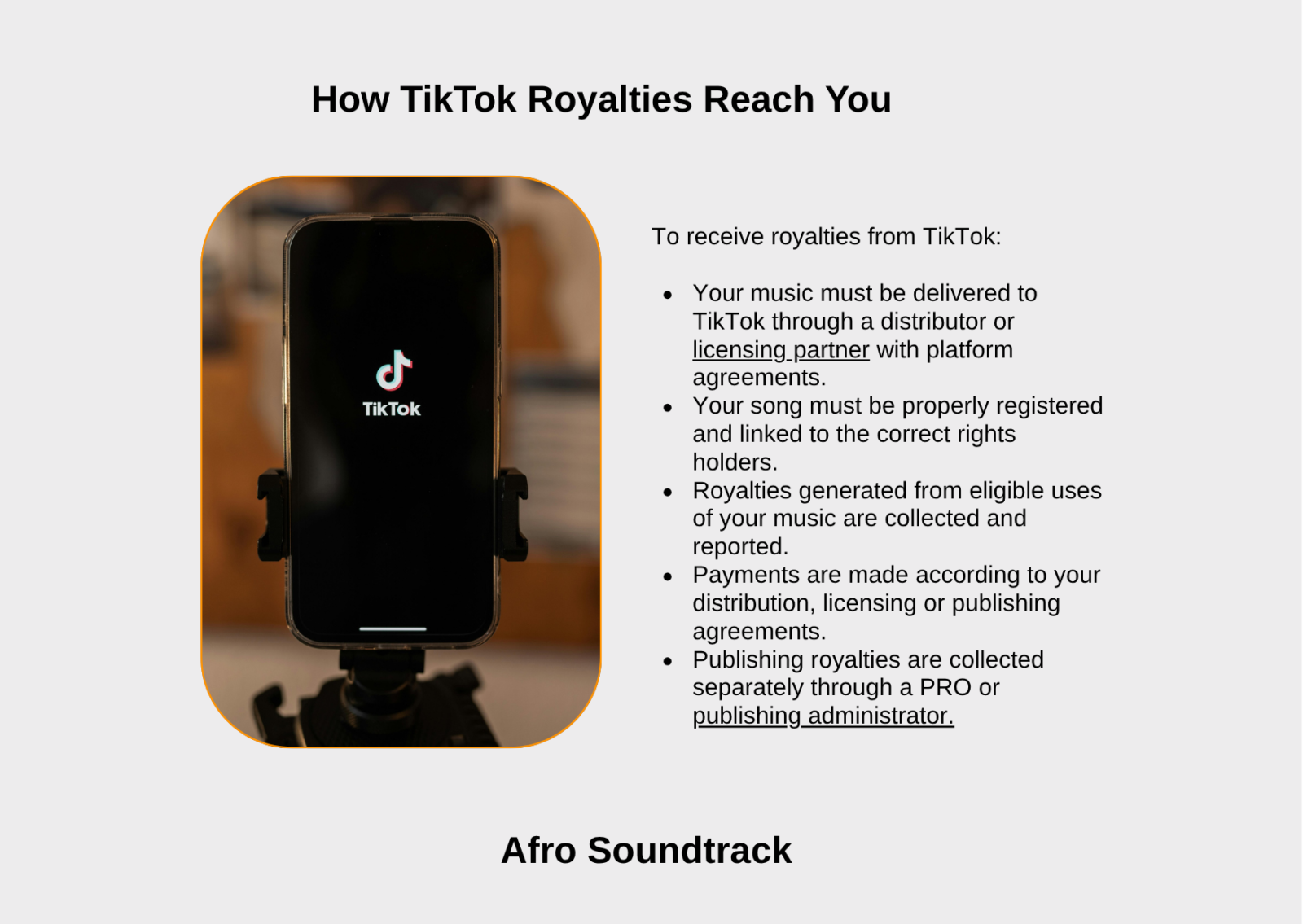
How TikTok Royalties Reach You
To receive royalties from TikTok:
- Your music must be delivered to TikTok through a distributor or licensing partner with platform agreements like Afro Soundtrack.
- Your song must be properly registered and linked to the correct rights holders.
- Royalties generated from eligible uses of your music are collected and reported.
- Payments are made according to your distribution, licensing or publishing agreements.
- Publishing royalties are collected separately through a PRO or publishing administrator.
At Afro Soundtrack, we help African music creators license and deliver their music to platforms like TikTok, making their songs available within the platform’s official music library while also ensuring the necessary rights and royalty infrastructure is in place. That way, when your music starts gaining traction, it is properly positioned to earn.
How Do Instagram, Facebook and YouTube Pay Artists?
Instagram and Facebook (Meta)
Meta holds blanket licensing agreements with major labels, distributors and publishers that cover music use across Instagram, Facebook, Reels, Stories, Threads, Messenger and WhatsApp.
Unlike streaming services, there is no fixed per-stream payment rate. Instead, royalties are pooled and distributed based on usage data. Songs used more frequently across user-generated content generally receive a larger share of the royalty pool.
As with TikTok, music selected directly from Meta’s licensed music catalogue is generally easier to track and monetise than music that appears only in externally uploaded videos.
One Important Thing to Know
Not all accounts have the same music access.
- Personal and creator accounts: full access to licensed music libraries
- Business accounts: restricted to Meta Sound Collection and royalty-free tracks
- Business accounts using commercial music without a licence: muted audio or removed content
YouTube
YouTube operates one of the most sophisticated music rights systems in the world: Content ID. Content ID scans uploaded videos and compares them against a database of registered recordings.
When a match is found, rights holders can:
- Block the video.
- Claim advertising revenue.
- Monitor the video’s performance.
For African music creators, this creates a powerful passive revenue opportunity. Your music can appear in thousands of user-generated videos, while Content ID automatically identifies usage and routes revenue back to the rights owner.
Provided, of course, that the rights are properly registered.
What Registration Actually Means for Your Catalogue
For African music creators, the registration gap is where most money gets lost. A track can be streamed or used across millions of social media posts, but if the metadata is incomplete or the rights are not properly registered, the royalties have no destination. They either sit in limbo or get redistributed to someone else.
Every Music Track Needs
- An ISRC (International Standard Recording Code) for the sound recording.
- An ISWC (International Standard Musical Work Code) for the composition.
- Accurate ownership information.
- Correct songwriter and producer splits.
- Consistent metadata across every platform.
Even one missing registration can delay or prevent royalty payments.
The Territory Coverage Problem Facing African Music Creators
Social media platforms collect and distribute royalties through local collecting societies in different countries. If the royalties your music generates on TikTok in the UK, or on YouTube in Germany, are not being claimed by someone with representation in that territory, that money can sit in a pool that never reaches you.
Some of it expires, some of it gets redistributed to other rights holders in what the industry calls black box royalties: money that was collected but never matched to the correct owner.
This is one of the most invisible and persistent problems facing African music creators in the global streaming economy. Your music travels but money does not always follow.
How Afro Soundtrack Collects Social Media Royalties for African Music Creators
Understanding the system is one thing but having a partner who navigates it on your behalf is another.
Afro Soundtrack is a music tech and monetisation platform built specifically for African creators. Our work starts before your music is even released and continues for as long as your catalogue exists. We handle the infrastructure that positions your music to earn across every platform it touches, including TikTok, Instagram, YouTube, Facebook and beyond.
What We Do For Your Catalogue
- We license, register, track and collect royalties from TikTok, Meta, YouTube and other digital platforms on behalf of African music creators.
- Our collection is not limited to Nigeria or Africa. If your music generates usage in the UK, the EU or North America, we have the representation infrastructure to pursue those royalties and make sure they reach you.
- Support publishing royalty collection through trusted global partners.
- Ensure catalogues are correctly registered and monetized.
- When platform policies shift, when licensing deals change, or when new royalty structures are introduced, we make sure your catalogue is positioned to benefit rather than lose out.
Ready to make sure your music is earning what it should?
Sign up here and Get the AfroSoundtrack app.