

How many streams do I need to make $1,000 on Spotify?
It is one of the most Googled questions in the African music industry. Spend enough time on creator forums and you will also find a related version: how much is 100 million streams worth? Both questions sound reasonable. Neither of them is asking the right thing.
Why? Because it assumes something that is not true.
Streaming numbers may come in packs, but they are not valued in packs. At the surface, streaming feels borderless. A song can travel from Lagos to London, Accra to New York, almost instantly. But when it comes to revenue, the system does not calculate what you receive based on how many streams you have. It calculates based on where those streams came from.
So the better question is not how many streams you need. The better question is: how do my streams translate into money? Because streaming is only one part of the revenue pie. And even within the constraints of geography and platform economics, there are still things you can do to maximize your earnings.
The Two Variables Behind Every Streaming Payout
Streaming income is shaped by two core dynamics. Miss either one, and the economics stop making sense.
(i) The territorial value of your streams
(ii) Your ownership and rights infrastructure
Let’s get into them:
(i) Territorial Value of Your Streams
By territorial value, we mean that streams are not priced equally across the world. A stream in Nigeria does not generate the same revenue as a stream in the United States or the United Kingdom.
This difference is driven by a few underlying factors: subscription pricing, the ratio of premium to free users, and the strength of advertising markets in each territory. In simpler terms, how much money is available in a market determines how much gets paid out.
So how do DSPs actually calculate what flows back to you?
Platforms like Spotify operate a pro rata model, often referred to as the streamshare system. Here is what that means:
All the revenue generated in a given territory over a specific period, from subscriptions and ads, is pooled together. That pool is not yours yet. It is shared across all rights holders based on their share of total streams.
So if Nigeria generates a certain amount in subscription and ad revenue in a month, that becomes Nigeria’s royalty pool. If your music accounts for 1 percent of all streams in that market, you are entitled to roughly 1 percent of that pool, subject to rights splits and deductions.
Two important implications come out of this:
First, the size of the pool matters. A country with lower subscription prices and a higher proportion of free users will have a smaller pool. That means even high streaming numbers may translate into relatively lower payouts.
Second, your share of streams matters more than your absolute stream count. One million streams in a smaller market does not carry the same economic weight as one million streams in a higher value market.
This is why asking “how much is one million streams worth” without asking where those streams came from will always give you an incomplete answer.
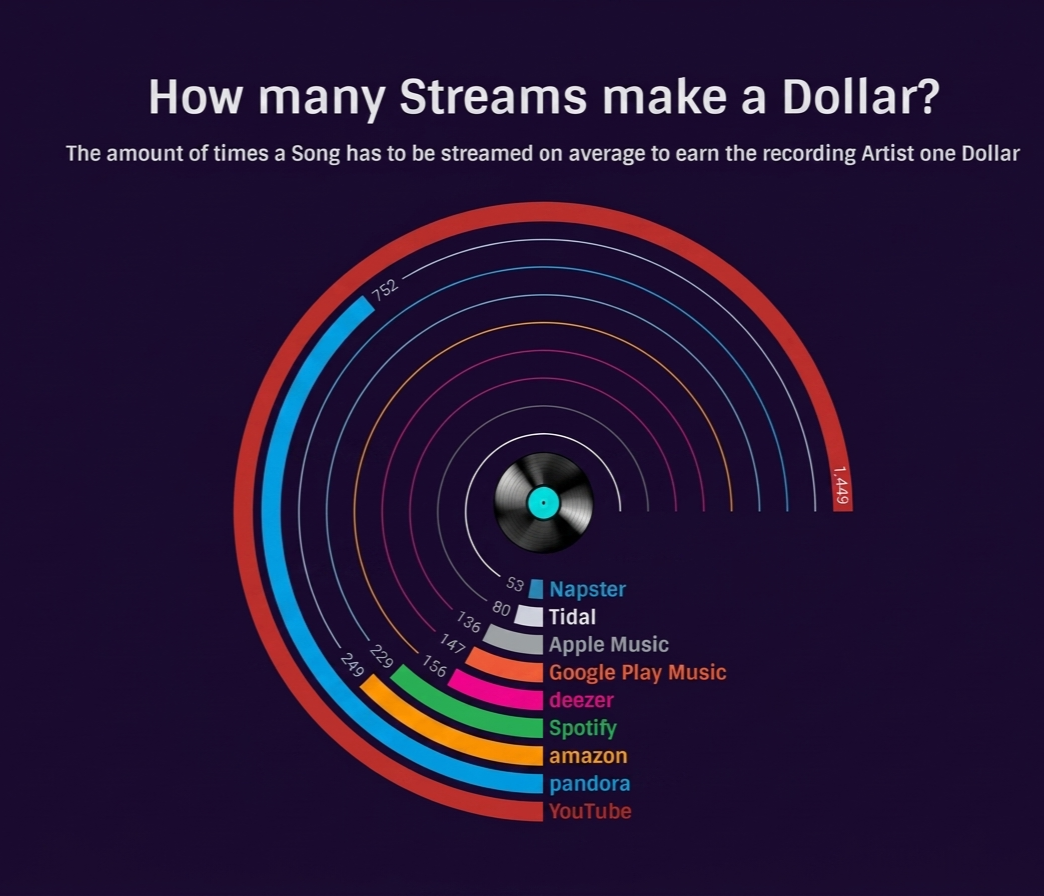
While these figures provide a helpful benchmark, actual payouts are determined by the ‘streamshare’ model, where the value of a stream is dictated by the specific revenue pool of the listener’s territory.
(ii) Ownership and Rights Infrastructure
Now this is where it gets more interesting. Territorial value is only one side of the equation. The second, and often more decisive factor, is your rights infrastructure.
Afrobeats is estimated to have generated roughly $100 million globally in 2023. Yet only a fraction of that value makes its way back to the artists, producers, and African music creators behind it.
Why? Because, a significant number of African music creators operate with incomplete rights setups. That includes:
- Missing publishing administration
- Unregistered works
- Unclear ownership splits
- Limited access to global royalty collection systems.
To understand why this matters, you need to look at how streaming money is actually broken down.
Every stream generates multiple layers of royalties:
- Master royalties, tied to the sound recording and typically collected through distributors or labels
- Publishing royalties, tied to the underlying composition and processed through a separate, more fragmented system
Most creators are plugged into the master side. The publishing side is where the leakage happens. Publishing income does not flow automatically but depends on three things working correctly at the same time:
- Registration with a performing rights organisation
- Accurate metadata linking the composition to the sound recording
- Active administration across all territories where the music is consumed
This is where scale creates friction. In more fragmented systems, especially across emerging markets, this leakage becomes even more pronounced. Data may not be properly matched, royalties may sit unclaimed and cross-border collections may never be fully reconciled.
When a Nigerian record travels globally, its royalties are no longer handled in one place. In the United Kingdom, mechanical and performance royalties are handled through licensing and collection systems like PRS for Music. In Germany, performance income is collected by GEMA. In Japan, usage is tracked by JASRAC.
Each of these systems calculates royalties independently and each requires clean data to match usage to a rights holder.
When that data is incomplete or missing, the royalties do not disappear. They sit in holding accounts, waiting to be claimed. Over time, they are absorbed into what the industry calls the “black box” and redistributed to rights holders with complete and verifiable data.
So this means that two songs can generate the same number of streams in the same markets. One earns significantly more, not because it performed better, but because it is properly registered, administered, and globally connected.
According to CISAC, global creator royalties reached 13.97 billion euros in 2024, with digital income continuing to grow at double-digit rates. African music is contributing to that growth but the share that flows back to African creators, however, does not fully reflect that contribution.
So while territory determines how much a stream is worth, your rights infrastructure determines whether you actually receive that money. In practical terms, two artists can have the same number of streams in the same countries and still earn very different amounts. In this context, structure becomes the difference.
So What Are Nigerian Streams Actually Worth?
At first glance, low subscription penetration in markets like Nigeria looks like a disadvantage. And maybe it is. Premium adoption is still growing, and ad-supported listening makes up a large portion of consumption but there is a second layer to this that is often missed.
Even though premium penetration is lower, the cost of acquiring a paying listener is significantly different across markets. In high-income territories like Denmark, Sweden, or the United States, one premium subscriber represents a relatively high revenue yield per user. But that same user is also harder to acquire, more saturated with competing platforms, and more selective in consumption patterns.
In a market like Nigeria, the economics is different. Because subscription pricing is lower and digital entertainment adoption is still expanding, it is often easier to convert multiple listeners into sustained engagement. In practical terms, it may take the same level of effort, promotion, or virality to generate four active listeners in Nigeria as it takes to acquire one premium listener in a higher-value market.
But cost is only part of the story. Cultural alignment matters just as much.
Listeners in Nigeria are not just cheaper to acquire. They are also more likely to already sit within the cultural and sonic ecosystem your music comes from. Shared language, trends, social context, and listening habits reduce friction. Discovery is faster, adoption is more organic, and repeat listening is more likely, and this has a compounding effect.
Instead of fighting for attention in a saturated foreign market where your sound may still be “emerging,” you are operating within a home market where your music is already contextually understood. That familiarity lowers acquisition cost and increases retention at the same time.
So maybe instead of only asking how much one stream is worth, you begin to ask:
How efficiently can I convert attention into repeated listening at scale?
Because streaming platforms do not only reward geography. They reward consistency of consumption. A catalog that generates repeated engagement in lower Average Revenue Per User (ARPU) markets can still accumulate meaningful streamshare within that territory’s royalty pool.
This is also where the pro rata system becomes important again. Even if individual streams are lower in value, sustained high-volume listening increases your share of the total pool in that market. And that share is what ultimately determines payout.
So while a single premium listener in Denmark may generate more revenue per head, multiple engaged listeners in Nigeria, who understand the sound, engage more frequently, and are easier to acquire, can collectively drive significant stream volume within a different economic structure.
This does not remove the territorial disparity but reframes the strategy. Because in streaming economics, value is not only about where your listeners are. It is also about how efficiently you can scale attention within the cultural and economic realities of each market.
AfroSoundtrack: Turning Streams Into Real Revenue for African Music Creators
By now, the pattern is clear. Streaming income is not about how many plays you get, but where they come from, how they are valued, and whether your rights are structured to collect what you have earned.
This is where many African music creators lose money. The systems required to track, claim, and collect that income are often incomplete or entirely missing. This is the gap AfroSoundtrack is built to close.
AfroSoundtrack provides publishing administration tailored specifically for African music creators. This means ensuring your compositions are properly registered, your metadata is accurate, and your rights are connected to global collection systems across multiple territories.
Instead of leaving royalties sitting unclaimed across different markets, AfroSoundtrack works to ensure your music is fully accounted for wherever it is consumed. Because when your song streams in the United States, Germany, or Japan, those royalties should not remain in foreign systems. They should flow back to you.
Beyond registration, the focus is also on giving you structure. Building a system where your master and publishing rights are aligned, your data is clean, and your global earnings are not fragmented.
In practical terms, this means:
- Capturing publishing royalties that would otherwise go uncollected
- Ensuring your music is properly represented across international rights systems
- Giving you clear visibility into how your songs are performing financially, not just in streams
The goal is simple: when your music works globally, your revenue should too. If you are building an audience, the next step is making sure you are structured to earn from it fully.
Your music is already working globally. Make sure your revenue does too. Get started with AfroSoundtrack.
Get the AfroSoundtrack app.


FREQUENTLY ASKED QUESTIONS
How much does Apple Music pay versus Spotify in Nigeria?
Apple Music generally pays more per stream than Spotify because it is fully subscription-based.In Nigeria, Spotify payouts are usually lower due to a large free-tier user base.
How much does YouTube Music pay per stream?
YouTube Music typically pays less per stream than both Spotify and Apple Music. This is because a large portion of its consumption is ad-supported, and ad revenue per user is relatively low in markets like Nigeria. On average, payouts can range from fractions of a cent per stream, but the real value of YouTube often comes from scale and discovery rather than per-stream earnings.
How do music royalties get calculated?
There is no fixed per-stream rate. It is calculated through a pro rata system. All revenue in a territory is pooled, the platform takes its share then artists are paid based on stream share.
How do I earn more from my music?
Focus on high-value markets, repeat listening, proper rights registration and clean metadata. More streams alone is not enough.
My music has millions of streams in Nigeria. Why is my payout so low?
Three likely reasons. First, Nigeria is one of the lowest-priced Spotify markets globally, which means the royalty pool each Nigerian stream draws from is smaller than in the US or UK.
Second, if most of your Nigerian listeners are on the free, ad-supported tier, each stream pays significantly less than it would from a Premium subscriber. The combination of low subscription pricing and high free-tier usage is the primary driver of lower payouts from African markets.
Third, you may not be collecting your publishing income. Beyond master royalties, there are songwriting royalties (mechanical and performance) that often go unclaimed if you’re not properly registered with a performing rights organisation (PRO) and a publishing administrator.
Should I focus on growing my audience in the US instead of Nigeria?
Not instead of. In addition to, and with a clear understanding of the timeline. US audience growth requires more marketing infrastructure, cultural translation work, and patience. Nigerian audience growth is faster, more organic for most African artists, and builds the cultural credibility and streaming volume that eventually signals to US platforms and curators. The most sustainable path is a large, loyal African base that earns you the algorithmic visibility to cross over.
What is the difference between master royalties and publishing royalties?
Master royalties are paid for the use of the actual sound recording, the audio file that people stream. These are collected through your distributor and paid to whoever owns the master rights. Publishing royalties are paid for the underlying composition, the song itself including its melody and lyrics. These are collected through performing rights organisations and mechanical licensing agencies, territory by territory, and require separate registration. Many African artists collect master royalties but miss publishing royalties entirely because the registration infrastructure is not in place.
What is the black box in music royalties?
The black box refers to royalties that have been collected by a licensing body but cannot be paid out because the rights holder cannot be identified or matched. This usually happens because of missing or incorrect metadata, unregistered compositions, or no affiliation with the relevant collecting society. Those unmatched funds are held for a defined period and then redistributed to registered rights holders in proportion to their verified usage. African artists are disproportionately affected because of lower rates of PRO registration and metadata completeness.
If Nigerian streams pay less, why do streaming platforms even expand into Nigeria?
Because the economics of market expansion are not only about current per-stream value. Spotify and other DSPs are making a long-term bet on subscriber conversion. Nigeria has one of the largest youth populations in the world and significant mobile-first digital adoption. Setting a low entry-level price now is a user acquisition strategy. As income levels rise, card infrastructure matures, and telco billing integrations expand, Premium conversion rates are expected to grow. For Nigerian artists, that means the per-stream value of your Nigerian audience is not fixed. It is a developing number.
Do I need a publisher to collect publishing royalties?
Yes, because self-administration has limits in terms of the territories it actively covers and the back-catalogue it can reclaim. A publishing administrator or distributor with publishing services like Afro Soundtrack can provide broader global coverage, proactive registration, and access to mechanical royalties in markets like the US.