
If you’re a Nigerian or African artist, producer, or songwriter (composer) trying to make sense of music royalties, you’re not alone.
The music business can feel like a maze of confusing terms, percentages, and payment streams.
And when we say “composer,” we’re talking about everyone who helps shape a song: the person who wrote the lyrics, the producer who built the beat, the guitarist who added the groove, or the creator of that small melody that made the track unforgettable.
Two of the most important concepts you need to understand are publishing royalties and master royalties because knowing the difference could mean thousands (or even millions) of naira in your pocket.
Let’s break it down in the simplest way possible.
What Are Music Royalties?
Music royalties are payments earned when your music is used. Every time your song is:
- Streamed
- Played on radio or TV
- Used in a movie, advert, game, or documentary
- Performed live
- Downloaded
- Used on YouTube or TikTok
Someone is earning money from that usage.
But one song does not generate just one royalty. A single track actually creates two separate assets, each with its own income stream:
- The Composition (the song itself i.e the melody, lyrics, and musical arrangement).
- The Master Recording (The specific audio file people listen to on Spotify or Boomplay).
Each asset pays different royalties to different rights holders. This is the foundation of music income.
Publishing Royalties (The Composition Side)
What Are Publishing Royalties?
Publishing royalties are payments you earn as a composer, meaning anyone who created part of the song itself.
This includes the songwriter who wrote the lyrics, the producer who composed the beat, the session musician who created that guitar riff or piano melody, or anyone who contributed to building the actual composition.
Think of it this way: if you wrote “Last Last” but Burna Boy recorded it, you’d earn publishing royalties as the writer, even if you never stepped into the recording studio. The same goes for the producer who made the beat or the guitarist who composed the hook.
Who Gets Publishing Royalties?
Publishing royalties are earned by:
- Songwriters
- Composers
- Producers who contribute to the composition
- Session Musicians who contribute to the composition e.g Lead Guitarist, Saxophonist etc
- Anyone who owns a share of the writing
Publishing royalties come from:
- Radio airplay
- TV broadcast
- Music Streaming platforms (e.g Spotify, Apple Music, Youtube Music etc
- Audio Visual Platforms (e.g Tiktok, Instagram, Youtube, Facebook, Snapchat etc)
- Live performances
- Sync licensing (film, ads, games, etc.)
- User-generated content (TikTok, YouTube, Instagram)
Types of Publishing Royalties
Publishing royalties come in several forms:
- Performance Royalties
Performance royalties are earned whenever your song is performed publicly. This includes radio plays, live concerts, TV shows, malls, clubs, hotels, buses, or even a Lagos danfo.
Today, about 85 percent of performance royalties come from digital sources. These include streaming platforms like Spotify, Apple Music, Boomplay, and YouTube; digital download stores like iTunes; film and TV streaming platforms like Netflix, Showmax, and Amazon Prime; and even sync placements, where your music is used in movies, commercials, or online videos.
When your song plays on any of these platforms, they report that usage to Performance Rights Organizations (PROs).
These PROs then collect the money owed and pay it directly to you (or your publisher if you have one).
For example, when someone streams your song on Spotify in Germany, Spotify reports that play to the local PRO in Germany, who then works with your Nigerian PRO to get your money to you.
This network of PROs around the world ensures you get paid no matter where your music is played.
In Nigeria, performance royalties are collected by MCSN (Musical Copyright Society of Nigeria). Internationally, there’s BMI and ASCAP in the USA, SOCAN in Canada, IMRO in Ireland, PRS in the UK, and many others around the world. You typically need to register with a PRO in your home country, and they’ll work with PROs globally to collect your royalties wherever your music is played.
- Mechanical Royalties
Mechanical royalties are earned whenever your song is reproduced or streamed. Every play on Apple Music, Spotify, Boomplay, or Audiomack generates mechanical royalties.
Here’s the catch. Mechanical royalties cannot be collected directly by you as a composer because the infrastructure is too complex for an individual to navigate alone.
These royalties are generated across hundreds of streaming platforms and digital services in dozens of countries, each with its own payment systems and collection societies.
This is where a publisher or publishing administrator comes in. These companies are affiliated with Collective Management Organizations (CMOs) and licensing entities worldwide.
CMOs are organizations in different countries that collect mechanical royalties on behalf of rights holders. Think of them as the mechanical royalty equivalent of PROs, but for reproductions and streams rather than public performances.
When your song is streamed on Spotify in Brazil, the mechanical royalty is collected by the local CMO.
Your publisher or publishing administrator, being affiliated with that CMO and others worldwide, tracks your usage, claims your royalty, and gets it paid to you.
Without this global network, you would miss out on most of your mechanical royalties because you simply wouldn’t have access to these systems.
At Afro Soundtrack, we handle this process for you. We take care of the administrative work so you can focus on creating music while still getting paid everywhere your songs are used.
Why African Songwriters Lose Publishing Royalties
Despite the global success of African music, many music creators never receive their publishing money because of:
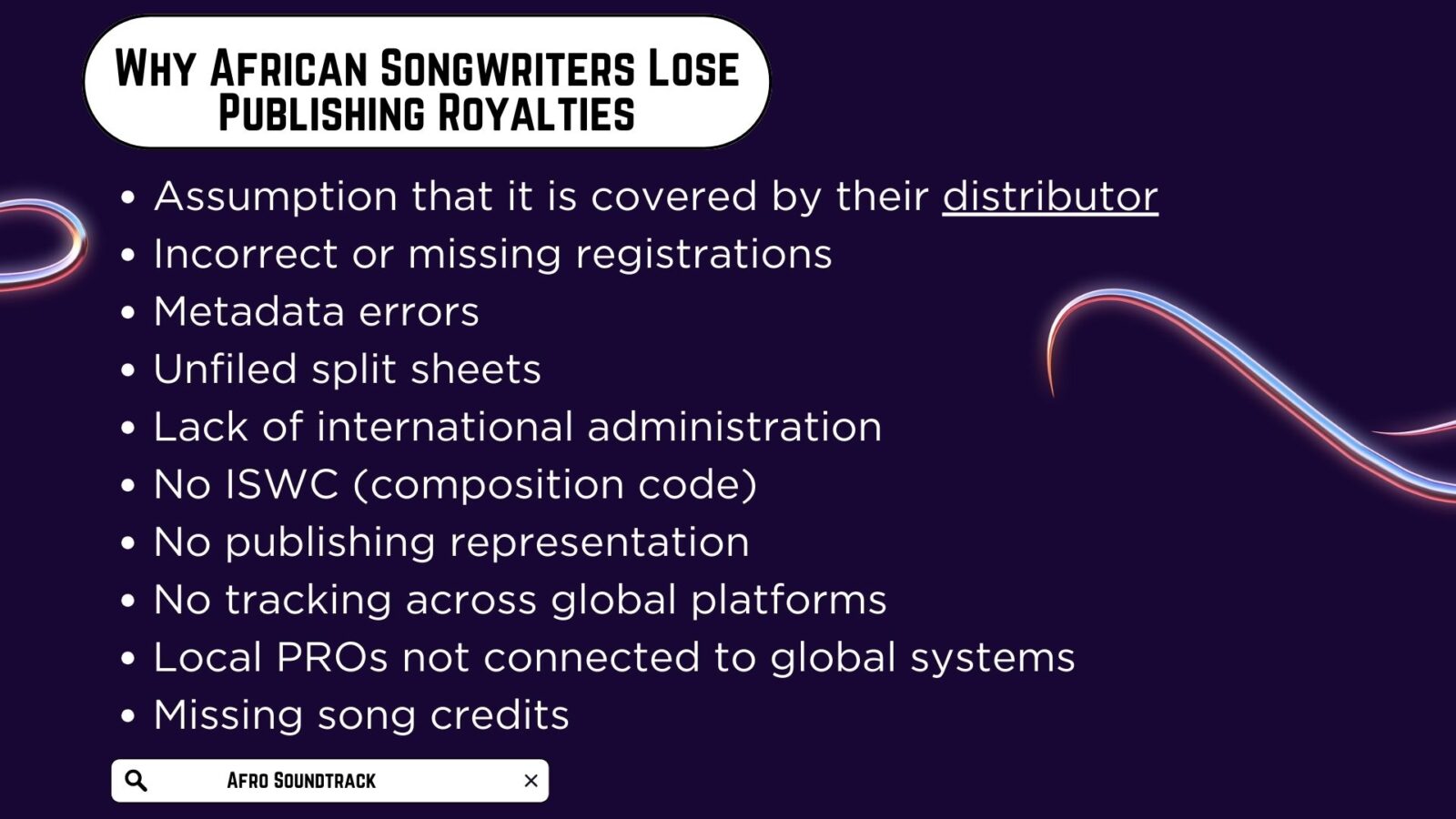
- Assumption that it is covered by their distributor
- Incorrect or missing registrations
- Metadata errors
- Unfiled split sheets
- Lack of international administration
- No ISWC (composition code)
- No publishing representation
- No tracking across global platforms
- Local PROs not connected to global systems
- Missing song credits
Billions of naira in publishing royalties go unclaimed every year especially from African music creators.
How Afro Soundtrack Helps Nigerian and African Songwriters Collect Publishing Royalties
Afro Soundtrack is a publishing administration and rights management company built specifically for African music creators. We help you collect the publishing royalties that normally get lost in the system.
Here’s what Afro Soundtrack does for Nigerian and African Music creators:
- Registers your songs globally
- Tracks publishing royalties across platforms
- Handles publishing splits and paperwork
- Collects royalties from sync uses
- Protects your songwriting rights
- Helps get your music placed in film, ads, video games, and more
- Pays you accurately and transparently.
This is huge because publishing royalties often form 10–20% of all the money a song can make. If you’re only collecting your master royalties, you are leaving half your income on the table.
Now, let’s move to the second major category.
Master Royalties (The Recording Side)
What Are Master Royalties?
Master royalties (also called recording royalties) are payments earned from the actual audio recording of your song. Whoever owns the master recording owns these royalties.
For instance, If you recorded “Last Last” in your bedroom studio and kept ownership of that recording, you’d earn master royalties every time that specific version is streamed, downloaded, or played.
Where Master Royalties Come From
- Streaming platforms (Spotify, Apple Music, Boomplay, Audiomack)
- Digital downloads
- YouTube Content ID
- Neighboring rights (in some countries)
- Sync placements (your recording used in visual media)
Who Earns Master Royalties?
- Independent artists
- Record labels
- Producers (if ownership is negotiated)
- Investors who funded the recording
- Multiple parties if splits were agreed
This is why “own your masters” is such a big conversation. Ownership determines who earns the long-term recording income.
How Master Royalties Are Paid vs. How Publishing Royalties Are Paid
Master royalties flow through your music distributoingr, such as:
- DistroKid
- TuneCore
- Boomplay
- CD Baby
- Audiomack
- Empire
- Ditto
- A label distribution deal
These platforms pay out the master royalties to whoever uploaded the song. This is why many Nigerian artists think:
“Streaming money = my only royalty.”
The Key Identifiers: ISWC vs ISRC
To fully track royalties globally, every song needs two universal identifiers:
1. ISWC (Publishing Identifier)
ISWC (International Standard Musical Works Code)
This is the unique ID for the composition i.e the song itself.
What ISWC Identifies:
- The writers and their splits
- Ownership of the songwriting
- When/where the work was registered
- The composition as intellectual property
Without an ISWC:
- Your publishing royalties may not reach you
- Usage cannot be tracked internationally
- Writing splits may be disputed
- Global collections become impossible
Afro Soundtrack helps secure your ISWC so your publishing income is properly tracked worldwide.
2. ISRC (Master Recording Identifier)
ISRC (International Standard Recording Code)
This is the unique ID for a specific audio recording.
What ISRC Identifies:
- The exact version of a recording
- Ownership of the master
- Revenue owed to that recording
- Recording date and details
Without an ISRC:
- streaming platforms cannot pay you
- Your specific recording might not be monetised correctly worldwide
Why African Artists Are Losing Music Royalties
Many African artists, particularly in Nigeria, don’t fully understand these distinctions, leading to significant lost income. Here are common mistakes:
i. Not registering songs: If you don’t register your songs with a performing rights organization or collection society, you’re leaving money on the table every time your song plays on radio or gets streamed.
ii. Signing away everything: Some artists sign deals that give away both publishing and masters without understanding what they’re surrendering.
iii. Not collecting globally: Your music might be playing in the US, UK, or Brazil, but if you’re not set up to collect royalties internationally, someone else might be collecting your money or it’s just sitting unclaimed.
iv. Working without proper splits documentation: When multiple people create a song, failure to document publishing splits leads to disputes and payment delays.
How Afro Soundtrack Helps Nigerian Songwriters Collect What’s Theirs
This is where we come in as a game-changer for Nigerian and African songwriters. We are a music publishing company that specializes in collecting publishing royalties for Nigerian songwriters and composers.
We understand the unique challenges African artists face in the global music industry and have built systems to ensure you get paid for every use of your songs anywhere in the world.
The Afro Soundtrack Advantage
- Global Collection Network: This means when your song plays in London, Lagos, or Los Angeles, we’re tracking it and collecting your money.
- Transparency: You get clear, detailed statements showing exactly where your royalties are coming from, which platforms, which countries, and which uses.
- African Music Expertise: Unlike generic publishing administrators, Afro Soundtrack understands Afrobeats, Highlife, Amapiano, and the nuances of the African music market. We know the local collecting societies, payment timelines, and challenges specific to our continent.
- Registration Assistance: We help you properly register your songs with all the necessary organizations, ensuring your catalog is properly documented and protected.
- Education and Support: We don’t just collect your money, we also educate you on your rights, help you understand your statements, and empower you to make better business decisions.
- Sync Opportunities: We actively pitch music for Netflix, Showmax, Nollywood films, international adverts, video games, documentaries, and streaming series.
- Transparent dashboards and fast payouts: You can actually see where your money is coming from.
8. Support for independent and established creators: If you’re an upcoming songwriter in Surulere or a top producer in Cape Town, Afro Soundtrack can manage your publishing.
Why Work With Afro Soundtrack?
If you’re a Nigerian songwriter, here’s why partnering with Afro Soundtrack makes sense:
- You maintain ownership: We collect on your behalf, but you retain ownership of your publishing rights.
- Professional infrastructure: Building global collection infrastructure yourself is expensive and time consuming. We already have it in place.
- Focus on creating: Instead of chasing payments and dealing with international paperwork, you can focus on making great music while we handle the business side.
- Maximize your income: We’re actively looking for every possible revenue stream from your songs, from radio play to sync opportunities.
- Fair commission structure: Our commission is competitive and transparent, with no hidden fees or confusing calculations.
How to Set Up Your Publishing Correctly
Follow this simple checklist:
- Complete split sheets after every studio session
- Register with a PRO (globally recognized)
- Register your songs with Afro Soundtrack
- Ensure your metadata is accurate (ISRC + ISWC)
- Work with a trusted publishing partner like Afro Soundtrack
- Never let songs go out without proper credits
If you follow this, you will never lose publishing money again.
Taking Control of Your Music Career
Understanding the difference between publishing and master royalties is essential for any serious music professional. This knowledge empowers you to negotiate better deals, retain more rights, and maximize your income.
For Nigerian songwriters specifically, partnering with a specialized publishing administrator like Afro Soundtrack can be the difference between leaving money on the table and building sustainable wealth from your craft.
Remember: every song you write is an asset that can generate income for decades. Protect it, register it, and make sure you’re collecting everything you’re owed.
Your music is traveling the world. Make sure your royalties are too.
Ready to start collecting your publishing royalties? Speak to our Publishing Team at Afro Soundtrack today.