
Gospel music is a major cultural and digital force in Nigeria. It fills churches, performs strongly on streaming platforms, and drives engagement across social media and live events. Yet many Nigerian gospel artists, songwriters, and producers are not earning the full value of their work because they are not collecting from every possible source.
This is the core issue. While some music creators earn from performances or distribution, a significant portion of income lies in publishing: songwriting royalties, performance royalties and mechanical royalties. These revenues do not disappear; they go uncollected when gospel songs are not properly registered or administered.
Many Nigerian gospel music creators operate without publishers or publishing administrators. As a result, they lack the systems needed to track, collect, and enforce their rights globally. This leads to a situation where money generated from streams, church performances, and international usage is left unclaimed.
The Scale of Nigerian Gospel Music Revenue
Before examining where income is being lost, it is important to understand the scale of the opportunity.
Nigerian gospel music has achieved genuine global reach. Nathaniel Bassey recently reached 440 million streams on Spotify alone, becoming the most streamed Nigerian Gospel Artist on the Platform. Sinach’s Way Maker is one of the most recognised songs to come out of Africa in the past two decades, covered and performed by congregations on every continent. Nigerian Gospel Artists consistently rank among the most streamed musicians in sub-Saharan Africa. Even new and emerging gospel creators are also gaining traction, further expanding the reach of the genre. The opportunities have never been greater.
Beyond streaming numbers, Nigerian gospel music drives cultural moments with measurable commercial value. The Hallelujah Challenge, initiated by Nathaniel Bassey, draws participants from across the world each time it runs. Live gospel concerts in Lagos, Abuja, and Port Harcourt regularly fill arenas. Gospel music content on YouTube generates billions of combined views. The sound continues to evolve, blending with Afrobeats and contemporary worship styles in ways that make it more accessible to intrdsernational listeners and more attractive for global opportunities.
Revenue is already being generated across every part of this ecosystem. What is missing is a mindset of ownership and enforcement, where Nigerian Gospel music creators actively ensure that publishing income is tracked and paid back to them.
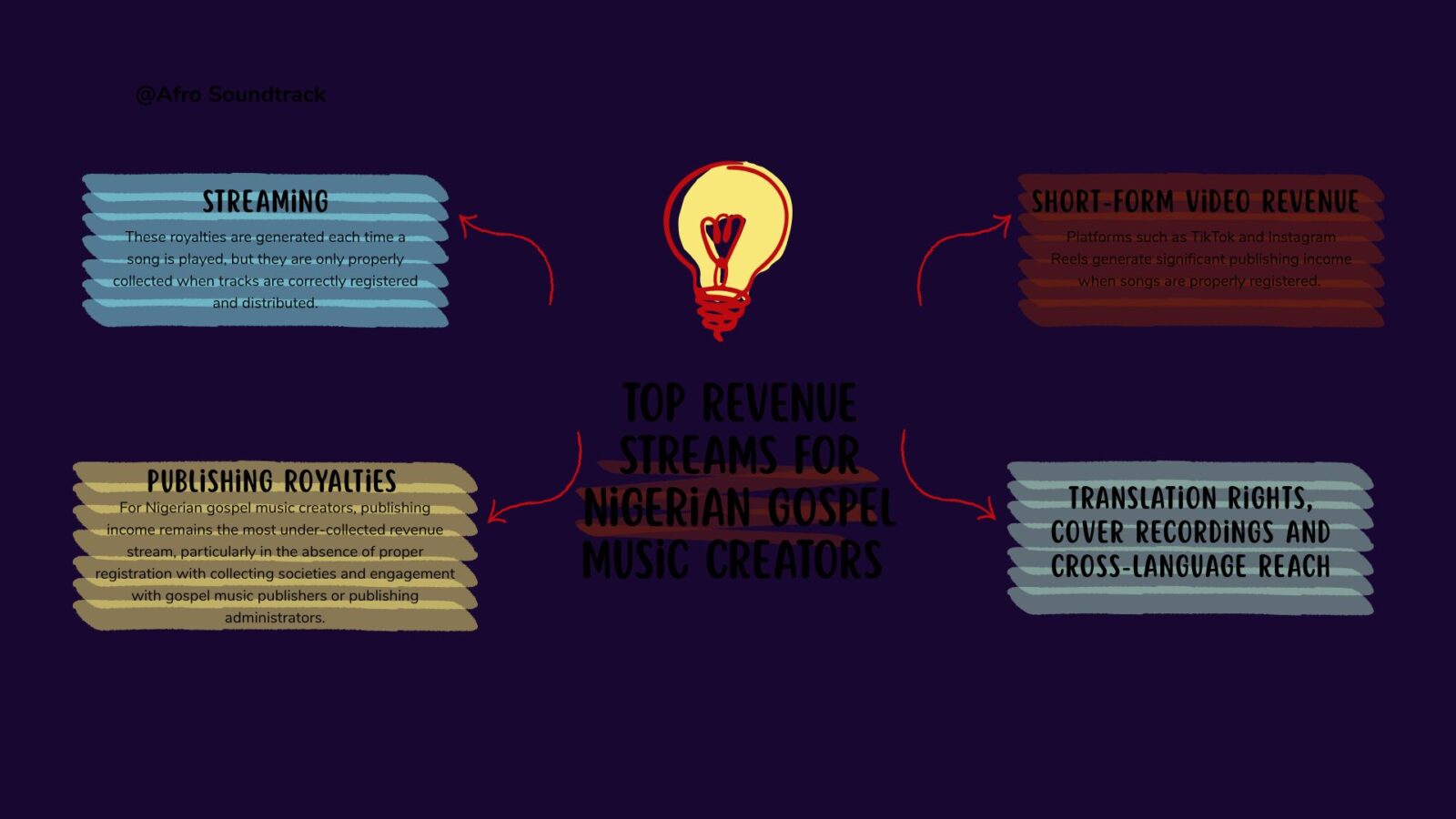
Top Revenue Streams for Nigerian Gospel Music Creators
i. Streaming Royalties
Streaming royalties are paid by platforms such as Spotify, Apple Music, Boomplay, and YouTube for every stream. These royalties are generated each time a song is played, but they are only properly collected when tracks are correctly registered and distributed.
ii. Publishing Royalties
Publishing royalties include performance royalties and mechanical royalties. Performance royalties are earned when songs are performed publicly in churches, concerts, on radio, or at events. Mechanical royalties are generated from streams, downloads, and reproductions of the composition.
For Nigerian gospel music creators, publishing income remains the most under-collected revenue stream, particularly in the absence of proper registration with collecting societies and engagement with gospel music publishers or publishing administrators.
iii. Short-Form Video Revenue
Platforms such as TikTok and Instagram Reels generate significant publishing income when songs are properly registered. Viral sound usage drives global exposure and recurring royalty payments, especially when songs are accurately tracked across multiple territories.
iv. Translation Rights, Cover Recordings and Cross-Language Reach
Translation rights are one of the most overlooked but commercially viable revenue streams for Nigerian gospel music creators. These rights allow a song to be translated into another language while retaining the original composition’s ownership and royalty structure. In practical terms, this means a Yoruba or Igbo worship song can be translated into French, Spanish, Portuguese, or Swahili and legally exploited in new markets while the original songwriter continues to earn publishing income.
This is particularly relevant given the global structure of Christianity. According to data from the Pew Research Center, over 2.3 billion people identify as Christians worldwide, with significant populations across Latin America, Europe, and Africa. Many of these regions actively engage with translated worship music in local languages. This creates a clear pathway for Nigerian gospel songs to travel beyond English-speaking and Nigerian audiences.
Cover recordings further expand this opportunity. When another artist records and releases a new version of an existing gospel song, the original songwriter earns mechanical royalties and, in many cases, performance royalties as well. This is standard practice in global gospel music ecosystems, where songs are frequently reinterpreted across denominations, choirs, and international ministries. For example, songs originally written in one country are often adapted and performed by church choirs in entirely different regions, generating recurring income for the original composer.
Cross-language reach also enhances discoverability on digital platforms. Streaming services and user-generated content platforms increasingly recommend music based on regional and linguistic preferences. A translated version of a song can therefore unlock new algorithmic exposure, leading to increased streams, more cover recordings, and additional licensing opportunities.
However, these revenue streams are only accessible when rights are properly managed. Translation rights must be formally licensed, and cover recordings must be tracked through publishing administration systems. Without proper registration and global publishing infrastructure, these uses may occur without compensation to the original creator.
For Nigerian gospel music creators, this represents a strategic shift. Instead of relying solely on local streaming income, they can position their music as global worship assets that can be translated, recorded, and performed across multiple territories, creating long-term publishing revenue.
Clearing Samples and Interpolations in Nigerian Gospel Music
Before Nigerian gospel music creators can fully maximise these revenue streams, it is important to address a critical area where income leakage and legal exposure often occur: the use of pre-existing musical material.
Sampling and interpolation are becoming more common in the Nigerian gospel music scene. However, when used without proper clearance, they create both legal and financial risks that directly affect publishing income.
Difference between a Music sample and an interpolation
A music sample uses part of an existing sound recording. This requires clearance for both the master recording and the composition. An interpolation on the other hand is the recreation of a melody or lyric. This requires clearance for the composition only. Religious intent does not remove these obligations.
How to clear samples or interpolations properly
- Identify the rights holders, usually publishers
- Obtain written permission before release
- Agree on usage terms, fees, and royalty splits
- Maintain proper documentation
If rights are not properly cleared, you expose yourself to serious risks, including:
- Copyright claims
- Loss of revenue
- Content takedowns
- Legal disputes
Clearing rights early is essential. Resolving issues after release is significantly more difficult and more expensive.
Choosing the Right Gospel Music Publishing Partner in Africa
For Nigerian gospel music creators, choosing the right music publishing partner is essential. You need a partner with a deep understanding of the local, regional, and global markets. The right publisher will register your works, track usage, and ensure you are properly monetised across multiple territories.
Here’s what to look for when choosing the right partner:
- Global Royalty collection
Your music publisher should have the ability to register and collect royalties across multiple territories. Without this, income from international streams and usage is often lost or delayed. Music Publishers like Afro Soundtrack operate with this kind of cross-border publishing infrastructure, helping African music creators access royalties across over 120 countries.
- Rights Administration for Covers, Translations and Global Exploitation
Your music publisher should have the ability to manage how your songs are reused, adapted, and exploited across different markets. Without this, translations and cover recordings often happen without proper licensing, credit, or payment.
A good music publishing partner will license translation rights, manage cover recordings, track usage across platforms, and collect mechanical and performance royalties from every version of your song. This ensures that every use is properly captured and monetised across multiple territories.
- Transparent reporting
You should know exactly where your earnings are coming from. This includes streaming, performance, mechanical, and sync royalties, broken down clearly by territory and source. Music publishing partners like Afro Soundtrack provide dashboard-based reporting so music creators can track performance and payouts in real time.
- Rights protection
A publisher should actively monitor usage, flag unlicensed exploitation, and help resolve royalty disputes where they arise. This ensures your catalogue is not just registered, but defended. Afro Soundtrack positions itself within this role by combining registration, tracking, and rights administration into a unified system for African gospel music creators.
Afro Soundtrack: Christian Music Publishing Administration in Africa
Afro Soundtrack is a music rights and monetization platform built specifically for African music creators, including gospel artists, producers, and songwriters across Nigeria and the wider continent.
We exist because African gospel artists are creating world-class music that is blessing people globally, but they are not earning the global income their music deserves. knowledge, and access.
Here is what Afro Soundtrack does for Nigerian and African gospel music creators:
- Song Registration and Publishing Administration
We register your original gospel compositions with PROs and rights bodies across multiple territories. This ensures that performance royalties, mechanical royalties, and any other publishing income generated globally are tracked and collected on your behalf. We handle the paperwork, the metadata, and the submissions so you can focus on creating.
- Translation, Cover Licensing and Global Rights Management
We ensure your music travels and earns beyond its original release. Afro Soundtrack manages translation rights and cover recording licences, making sure that when your songs are adapted into other languages or recorded by other artists, you are properly credited and paid.
We track these uses across platforms and territories, and collect the mechanical and performance royalties generated from each version. For gospel music that is frequently shared, translated, and performed across churches and ministries worldwide, this transforms informal usage into structured, trackable, and monetisable global income.
- Global Royalty Collection
Nigeria is one country. Your music reaches the world. Afro Soundtrack ensures your royalties are collected across the global rights ecosystem, where music income is generated and distributed on a territory-by-territory basis.
The global royalty system is not centralised. It operates through national collection societies and licensing bodies that manage rights within specific territories. For example, performance royalties are administered through organisations such as PRS for Music in the United Kingdom, ASCAP and BMI in the United States, SOCAN in Canada, and similar collective management organisations across Europe, Africa, Asia, and Latin America. These organisations operate under reciprocal agreements coordinated globally through CISAC, the International Confederation of Societies of Authors and Composers, which connects over 200 societies in more than 100 countries.
This structure means every use of your music is tied to a specific jurisdiction. If your work is not correctly registered and linked across these territories, those earnings are often delayed, misreported, or not paid at all.
We work within this fragmented system by ensuring your works are registered, matched, and tracked across multiple territories simultaneously. In practical terms, this ensures your music is not limited to a single market structure. It is recognised across interconnected rights territories, allowing royalties generated in different parts of the world to flow back to you in a coordinated and traceable way.
- Music Library Access for Christian Media
Our growing catalog of music titles includes gospel and worship music available for licensing to Nollywood productions, Christian TV channels, YouTube ministries, and online content creators. Being in our library means your gospel music is being considered for placements even when you are not actively pitching.
Who Afro soundtrack Works With
Afro Soundtrack works with gospel artists, worship leaders, gospel music producers, choir directors, session musicians, and independent Christian music creators across Nigeria, Ghana, South Africa, Kenya, and the wider African continent. We have helped several African Gospel music creators earn royalties and licensing income from global sources, including many first-time earners who had never received a publishing royalty payment before working with us.
How to Get Started with Afro Soundtrack
If you are a Nigerian or African gospel artist, worship leader, or producer who has original compositions, the time to act is now. Every day that passes without registration is a day of royalties that may not be recovered.
Visit afrosoundtrack.com to learn more about our publishing administration services and how we can help you turn your gospel music catalog into a sustainable income stream. Your music is already blessing people across Africa and beyond. It is time to begin earning the full value of your creative work. Sign up with Afro Soundtrack today!
Frequently Asked Questions: Gospel Music Publishing in Africa
Where can Nigerian gospel music creators find publishing support?
Nigerian gospel music creators can work with publishing administration platforms that specialize in African music rights management and global royalty collection. Afro Soundtrack supports African music creators, including gospel artists, by helping them register works, collect royalties internationally, and manage translation rights and cover licensing. This ensures that songs are properly tracked, adapted, and monetised across multiple languages, platforms, and territories.
Do worship songs earn streaming royalties?
Yes. Streams on Spotify, Apple Music, Boomplay, and Audiomack generate mechanical and performance royalties. Most unpaid earnings come from poor registration or lack of publishing administration.
What is the difference between a music publisher and a music distributor?
A music distributor delivers your songs to streaming platforms and collects revenue from the sound recording (master rights).
A music publisher manages the composition rights. This includes:
- Performance royalties
- Mechanical royalties
- Sync licensing income
These are two completely different revenue systems.
How long does it take to start receiving publishing royalties?
After registration, publishing royalties typically take 3 to 6 months to start flowing.
This delay exists because collecting societies and digital platforms operate on reporting and payment cycles. In some cases, it can take longer depending on territory and usage data. The most important step is early registration. Ideally, songs should be registered before release so that all usage from day one is tracked and collected.
Can gospel music producers receive publishing royalties?
Yes. Producers can earn publishing royalties if they contribute to the composition, such as:
- Melody creation
- Lyrics
- Harmonic structure
- Arrangement with creative input
However, this contribution must be documented through split sheets and properly registered.] Production alone, such as creating beats without compositional input, does not automatically qualify for publishing income. Several gospel music creators working with publishing systems like Afro Soundtrack are already actively collecting royalties from their compositional contributions.
How is copyright protection applied to gospel music compositions?
Copyright protection automatically applies to original gospel music compositions as soon as they are created and fixed in a tangible form (written, recorded, or produced). However, protection alone is not enough to generate income. To monetize copyright effectively, gospel music creators must:
- Register their works with collecting societies and publishers
- Document ownership splits clearly
- Track usage across streaming platforms, radio, and live performances
- License their music properly for sync and commercial use
Without these steps, copyright exists in theory but not in practical revenue collection.