
Listen closely to Nigerian music and you will notice something: Nigerian producers leave their mark right at the start. “Ozedikus Nwanem.” “London.” “Tune into the King of Sounds and Blues.” That voice tag announces who made the sound.
Producers are essential to the music business. They build the beat, arrange the instruments, guide the recording, and shape the final song. In Nigeria, many also contribute melodies, structure the record, and help write the hook. Without them, there is no sound.
Yet most Nigerian producers still earn the old way: make a beat, sell it, get paid once, and move on. When the song becomes a hit, the artist earns, the label earns, and the producer often gets nothing more.
Selling beats should not be the only income stream. Nigerian producers can earn royalties just like performing artists. If your songs are properly registered and your rights are documented, producer royalties, publishing income, performance royalties, mechanical royalties, and sync licensing can keep money coming in long after the beat was made.
The problem is that many Nigerian producers do not know this system exists. Some think royalties are only for artists. Others assume publishing is only for songwriters.
If you are a Nigerian producer, you don’t have to rely on beat sales alone. Let’s show you the proven ways to earn more from your music.
How to Make Money as a Nigerian Music Producer
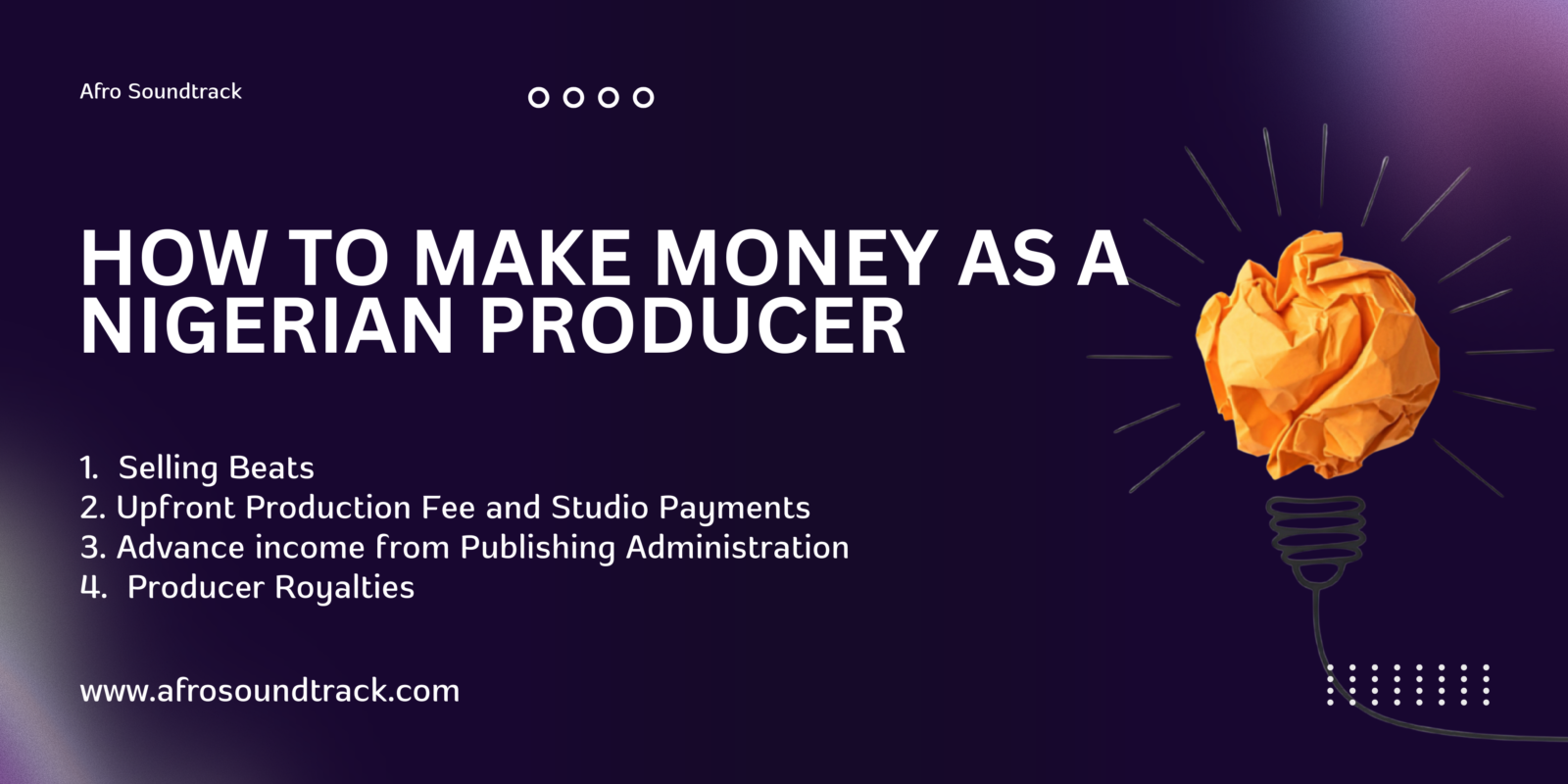
Many Nigerian producers believe selling beats or collecting studio fees is the only way to earn, but there are other proven ways to make money alongside these. These include:
- Selling Beats
Selling beats is the most familiar way to earn as a Nigerian producer. You create an instrumental and sell it to an artist for a fee. Depending on your reputation and the agreement, this fee can range from a small amount to millions of naira or dollars depending on the client.
Beat sales can take several forms:
- One-time payment
- Lease agreement
- Exclusive rights sale
- Direct sale via social media
- Beat marketplaces like BeatStars or Airbit
For many upcoming Nigerian producers, beat sales are the fastest way to get paid. But once the beat is sold without royalty rights in the agreement, you earn nothing else from the song, even if it goes viral, racks up radio play, or lands in a film or advert.
Beat sales alone are not a sustainable model. Your creative contribution deserves recurring income, not just a one-time fee.
- Upfront Production Fee and Studio Payments
Beyond selling a beat, you can charge for the full scope of production work: recording, arranging, mixing, sound design, and session direction. How much you earn depends on your experience, the artist’s budget, and whether a label is involved.
In Nigeria, it is common to receive both a production fee and a royalty share, especially with established artists. The relationship between these two is straightforward: a higher upfront fee typically comes with a lower royalty percentage, while a lower fee can mean a higher long-term share.
Industry practice often balances these two.
- High upfront fee usually means lower royalty percentage
- Low upfront fee usually means higher royalty percentage
Most professional producers include both upfront payment and royalty splits in their agreements. Without clear terms, problems arise the moment the song breaks. Discussing and documenting splits before a song drops protects everyone involved.
- Advance Income from Publishing Administration
A publishing advance is money paid upfront by a publisher based on the projected earnings of your catalog. It is not a gift; it is recovered from the royalties your songs generate over time. Think of it as a pre-investment in your music.
When a publisher pays an advance, they typically retain exclusive control over your catalog for an initial period, often around 3 to 5 years. If the Publisher has not recouped the advance by the end of the initial period, the catalog stays under their control for about 10 to 25 years. This period is called the retention period, during which royalties go toward recovering the advance before you begin earning income.
For Nigerian producers new to publishing, the smarter first step is often a publishing administration deal, rather than a full publishing deal. With publishing administration, you retain ownership of your catalog while an administrator like Afro Soundtrack collects royalties on your behalf from around the world.
The benefit is clear: once your catalog has a documented earnings history, you’re in a much stronger position to negotiate advances and better deals in the future. This approach protects your work, starts your royalty pipeline early, and sets you up for long-term income from your music, which is exactly what Afro Soundtrack helps Nigerian producers achieve.
- Producer Royalties
Unlike one-off fees, royalties keep generating income every time a song is used. Streams, radio plays, sales, and sync placements all trigger royalty payments. With the right agreements in place, one song can pay you for years.
Producer royalties come from two main sources:
- The composition (the melody, structure, and songwriting elements)
- The sound recording (the actual recorded performance you produced)
Many Nigerian producers miss out because their songs are not properly registered or because splits were never documented. When that happens, money that could be yours ends up elsewhere.
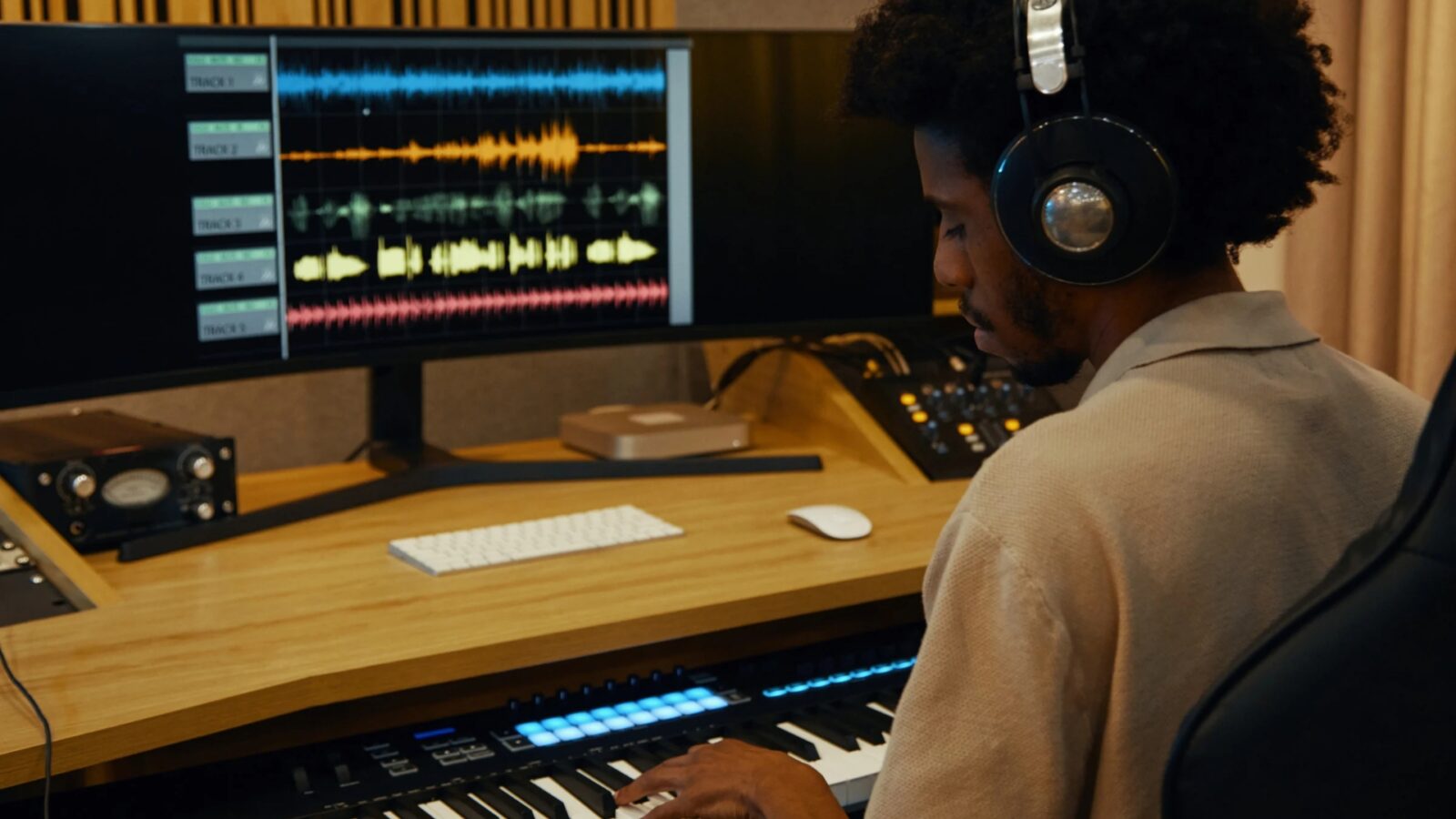
Types of Music Royalties Nigerian Producers Can Earn
- Performance Royalties
Every time a song is played publicly, performance royalties are generated. This includes radio stations, TV channels, streaming platforms like Spotify, Apple Music, Boomplay, and Audiomack, and public venues such as clubs, hotels, malls, and live events.
To earn your share, your name must be in the split agreement and the song must be registered with the relevant performing rights organizations (PROs). Once that is in place, the royalty belongs to you.
- Mechanical Royalties
Mechanical royalties are generated when the composition is reproduced, meaning every time someone streams or downloads the song. These royalties are tied to the composition itself, not just the recording, so anyone who helped create the music, including the producer, can earn a share with the right credit.
Mechanical royalties are difficult to collect independently. In most cases, you need a publisher or publishing administrator to collect them properly across various territories in the world.
- Sync Licensing Income
Sync royalties are earned when a song is licensed for use alongside video. This includes films, TV shows, adverts, video games, documentaries, and online content. Every placement requires a fee paid to the rights holders.
For Nigerian producers, sync licensing is one of the most valuable but underused income streams. Many songs could earn from film and television placements, but without proper registration, the money is never collected. If you own part of the composition, your approval is required before the song can be licensed, and you are entitled to a share of the payment
- Neighbouring Rights and Master Royalties
Apart from publishing income, producers can also earn from the sound recording itself. This happens when the producer owns part of the master or negotiated producer points.
In many deals, producers receive a percentage of the master income. This is often called producer points. It can be around 2 percent to 10 percent depending on the agreement.
Neighbouring rights are another source of income. These royalties are paid when the recording is played on radio, TV, or in public places. They are different from publishing royalties and can create another steady stream of money for the producer.
How Producer Royalties Are Calculated in Nigeria
In Nigeria, there is no single rule for producer royalties, but there are industry standards that most deals follow. The exact percentage depends on what was agreed before the song was released, how much the producer contributed, and whether the producer collected an upfront fee.
On the publishing side, the composition is usually divided into two halves:
- 100 percent is the writer and composer share
- 100 percent is the publisher share.
If a producer made the beat or helped create the melody, they are considered a writer and can claim a portion of the writer share when the composition is registered.
On the master side, producers can also earn through producer points if this was agreed in the contract. Producer points in Nigeria commonly range between 2 percent and 10 percent of the master income. Independent artists sometimes give more, while label deals may give less, especially if the producer collected a high production fee.
Think of it like baking a cake. If you only sold the flour, you get paid once and that is all.
But if you helped bake the cake, you deserve a slice every time the cake is sold. Publishing royalties are like owning part of the recipe, while master royalties are like owning part of the finished cake. If the cake keeps selling, your share keeps coming.
In Nigeria, royalties are not automatic. They only work when splits are discussed early, written down, and the song is properly registered. When this is done right, one song can pay a producer for many years.
Why Many Nigerian Producers Miss Out on Royalties They Could Receive
i. Relying only on upfront payment: You sell the beat, collect your fee, and move on. The song blows up later, everyone keeps earning, and your payment ended the day the beat was sold.
ii. Not registering the song: Royalties only work when the song is in the system. Without registration, the money has nowhere to go.
iii. No documented split agreement: When producers and artists never agree on percentages, the song can generate income and still not pay the right people.
iv. Trading royalties for a large upfront fee: A high one-time payment may end up being the smallest amount you earn if the song becomes a long-term hit.
iv. Thinking royalties are only for artists: Performance, mechanical, sync, publishing, and master points are all available to producers with the right agreements in place.
v. Not using a publishing administrator: Without proper administration, royalties from radio, streaming, TV, clubs, and sync can exist without ever reaching you.
vi. Waiting for an advance and losing out to black box royalties: Some Nigerian producers delay registration while waiting for an advance, and during that time royalties generated by their songs can go unclaimed and end up in the black box. Black box royalties are money collected by PROs, publishers, or streaming platforms that cannot be paid to anyone because the song was not properly registered or the ownership details were never submitted.
Why Many Nigerian Producers Should Start With Publishing Administration
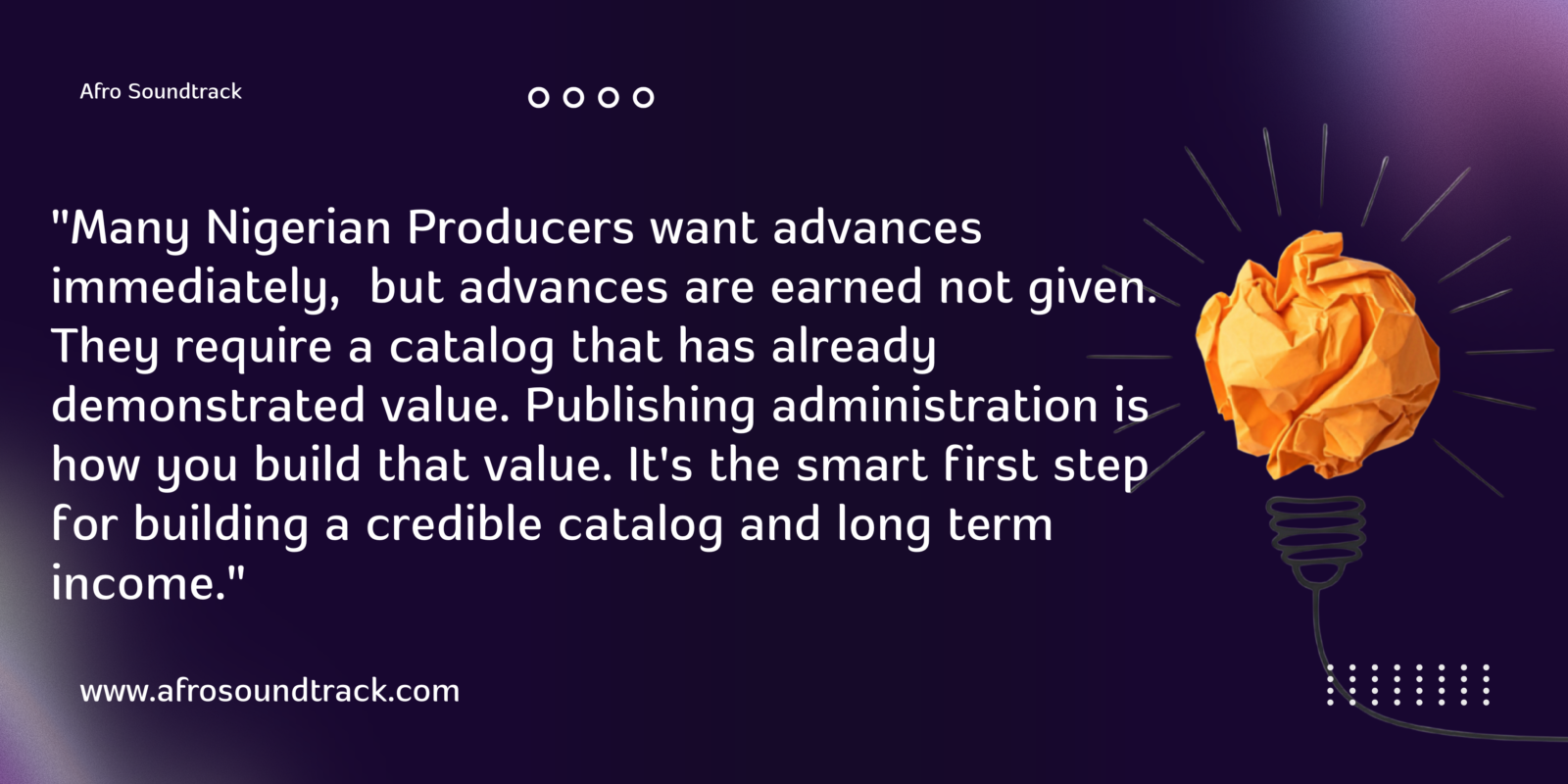
Many Nigerian producers want advances immediately, but advances are earned, not given. They require a catalog that has already demonstrated value. Publishing administration is how you build that value. It’s the smart first step for building a credible catalog and long-term income.
Unlike a full publishing deal where rights are transferred, publishing administration lets you retain ownership. You remain the ultimate owner of your music while the administrator handles the royalty collection.
With a publishing administration deal, you:
- Keep full ownership of your catalog:
- Collect royalties from platforms and societies around the world:
Many Nigerian producers miss income because they don’t know how to track plays across platforms, PROs, and licensees. A publishing administrator like Afro Soundtrack ensures royalties are collected globally, from streaming platforms, radio plays, and sync licenses.
- Build a real earnings history that labels and publishers can verify:
Publishers and labels are far more willing to offer advances or better deals when your catalog has a documented track record of income. Publishing administration allows you to establish a transparent, verifiable royalty history that proves your music has value.
- Create the leverage needed to negotiate larger deals later:
Once your catalog is generating income and your rights are properly registered, you are in a much stronger position to negotiate advances, splits, or full publishing deals. Instead of asking for money upfront with no proof, you demonstrate that your music already earns, reducing risk for the publisher or label.
- Lay the foundation for long-term royalties:
A properly registered and administered catalog ensures that every play, sync, or licensing opportunity is tracked and paid. This sets the stage for recurring income, turning your creative work into an ongoing revenue stream rather than one-off payments.
We do not take your rights. We help you earn from them.
In short, starting with publishing administration helps Nigerian producers grow their catalog, earn real royalties, and build negotiating power while keeping ownership. It is the smarter, more sustainable path to advances and bigger publishing deals.
How Afro Soundtrack Helps Nigerian Producers Collect Music Royalties Worldwide
Afro Soundtrack is a publishing administration platform built for African music creators, including Nigerian producers. We help producers register songs worldwide, track publishing royalties, collect performance and mechanical royalties, secure sync opportunities, and protect split agreements.
If you have songs already out, or songs coming soon, now is the time to make sure your music is working for you. One properly registered song can pay for years. A full catalog can change your income entirely.
Let Afro Soundtrack help you collect what you have already earned. Click here to get started.