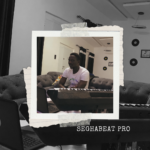

What began with playing piano in church eventually led Abatan Eniola, professionally known as Drilly, into music production, with credits on records like Kummie and Lojay’s Gorgeous and Kummie and Phyno’s 5AM. As his catalogue grows, so does his understanding of the business behind the music and the possibilities beyond production.
Afro Soundtrack sat down with Drilly to talk about finding his sound, navigating the business of music, building his catalogue, and figuring out what comes next.
Let’s go back to the beginning. How did you first get into making music and eventually become a producer?
It started from church. I come from a very artistic family. My grandpa used to play guitar for Sunny Ade, my dad was a music director in RCCG, and my mum is still very much in the choir. So, yeah, I come from a family of music.
I started playing the piano in church from a very young age, around Primary 3. I started playing professionally around SS2, and that was when I became more interested in music and started exploring another side of it, the digital world, where you could use your laptop to create things beyond what I was doing in church.
That’s when I discovered production. I realised you could make a complete song without even playing the piano, and that was quite intriguing to me. So I started developing myself, figuring things out, making friends and meeting people along the way.
I met Switch Beats, who’s like my right-hand guy, and we started putting things out. From there, I started working with Harry Maff and TML, and gradually, I started building my catalogue.
You’ve worked across different sounds and genres. If someone asked you to describe the kind of sound that feels most like you, what would you say?
I’d say it’s very melodic. I make very melodic music because I like my music to tell stories. I like to really interpret what I feel or what I hear through my music. If we’re talking about genre, I don’t think I have one particular genre. I’m very versatile, but I always like my music to have that melodic feel.
You’ve worked with artists like Lojay, Kummie and Phyno. Beyond making the beat, what do you think a producer brings to a song?
It’s very relative because, a lot of the time, the artist has the idea. Other times, the producer has the idea. Sometimes it’s just a bare idea from either side, and you build from there. So I genuinely think they both own the record, and the producer’s contribution is very important.
I think our role is to take the song where it’s supposed to go and interpret what the artist is feeling into the music. At the same time, how you want the song to go is also important, especially when you consider the brand and everything that comes with it.
So, for me, it’s about finding that balance between interpreting what the artist wants and making sure other people can also connect with and understand what you’ve created. That’s a really important role for the producer.
You started out in church before getting into music production professionally. When did you start becoming more conscious of the business side of music, like credits, ownership and publishing?
I had a very blurry idea of those things at first. I’d do my own research, go online, watch videos and try to understand what publishing and all of that meant. Then, when I started working with a management team, someone on the team would sit us down and explain these things to us. That was when I really started becoming more conscious of the business side.
They were getting ready to put some records out, and they wanted to make sure we understood what we were getting into and were protected. They even told us to get our own lawyers. So, yeah, that was really when I started understanding all these things better.
Before joining Afro Soundtrack, what did managing your catalogue, rights and royalties look like for you?
Before I joined Afro Soundtrack, I felt like I just needed somebody to help me put everything together. I was doing everything independently. I met my lawyer, Mr Bello Olanrewaju, when I was trying to get one particular job done, and we just clicked. Eventually, he became both my lawyer and my manager.
So I told him I needed some kind of structure where I could put all my stuff together. I wanted to focus on building my catalogue while they helped me handle my publishing and all of that. That’s how we reached out to Afro Soundtrack and got everything set up.
And since joining Afro Soundtrack, has managing your catalogue become easier?
Yeah, definitely. Now I have all my stuff together. If I have an issue, I know exactly who to reach out to and who I need to communicate with. I’m not trying to go from one person to another, one person to another, and basically do everything myself.
When you think about building a sustainable career as a producer, what does that look like for you?
I have this theory that, in the long run, you can’t just be a music producer. There are other parts of the music business you can get into. I’m actually starting to study how to become an executive, and that has nothing to do with production.
I love music, and I’ll keep making music, but I genuinely think it’s important to stay relevant beyond just production. You just have to figure out what works for you in the music space and build around that. For me, that’s what sustainability looks like.
I know some producers have interesting stories behind their names. How did you come up with yours?
It actually came from my friends. When I was learning production, I had a really supportive group of friends. I was the only person making music in our little clique. The others were video directors and creatives, and they were all doing their own thing.
At the time, I didn’t even have a laptop. So whenever they came around to colour grade or work on videos, I’d wait for them to finish, take whoever’s laptop was free, open FL Studio and try to make something.
They started liking what I was making for some reason. I was making really wack Amapiano, but they were very supportive. Then one day, we met a new friend who said he made music, and they introduced me like, “This our guy dey really drill beat o.” The name just stuck with me from then, and I decided to keep it.
Looking through your catalogue, is there a record you feel deserves more attention than it’s gotten so far?
I think I’m still observing that, to be honest. There’s “Gorgeous” by Kummie and Lojay. It’s such a beautiful record, and I really think it deserves to go further. But yeah, it’s still open. It keeps going up, then coming back down, then going up again. So I’m just watching it. Hopefully, it stays up forever.
What advice would you give to a music producer starting out in Nigeria right now?
Don’t get too comfortable, and show up every day. Sometimes, it’ll feel like you don’t have your shit together, but don’t let comparison steal your joy. You might compare yourself to people who have been in the industry for years without knowing how long they’ve been at it, then wonder how they suddenly made it.
Just keep showing up. One day, you’ll start meeting the right people, getting into the right rooms, and things will start to happen.
Get Paid For the Music You Make
Join Drilly and other music creators monetizing their work with Afro Soundtrack.