

In 2024, gospel music in sub-Saharan Africa crossed a threshold that few could have predicted. What began as a quiet momentum became an undeniable force.
Spotify Wrapped 2024 revealed that gospel music had claimed the ninth spot among the most streamed genres across the entire sub-Saharan region. But the real story was just beginning.
By 2025, the numbers told a more powerful tale. African gospel artists were not only sustaining momentum but outperforming several Afrobeats acts on major streaming platforms.
What was once viewed as a seasonal or church-centered genre had become part of everyday listening culture across Sub-Saharan Africa.
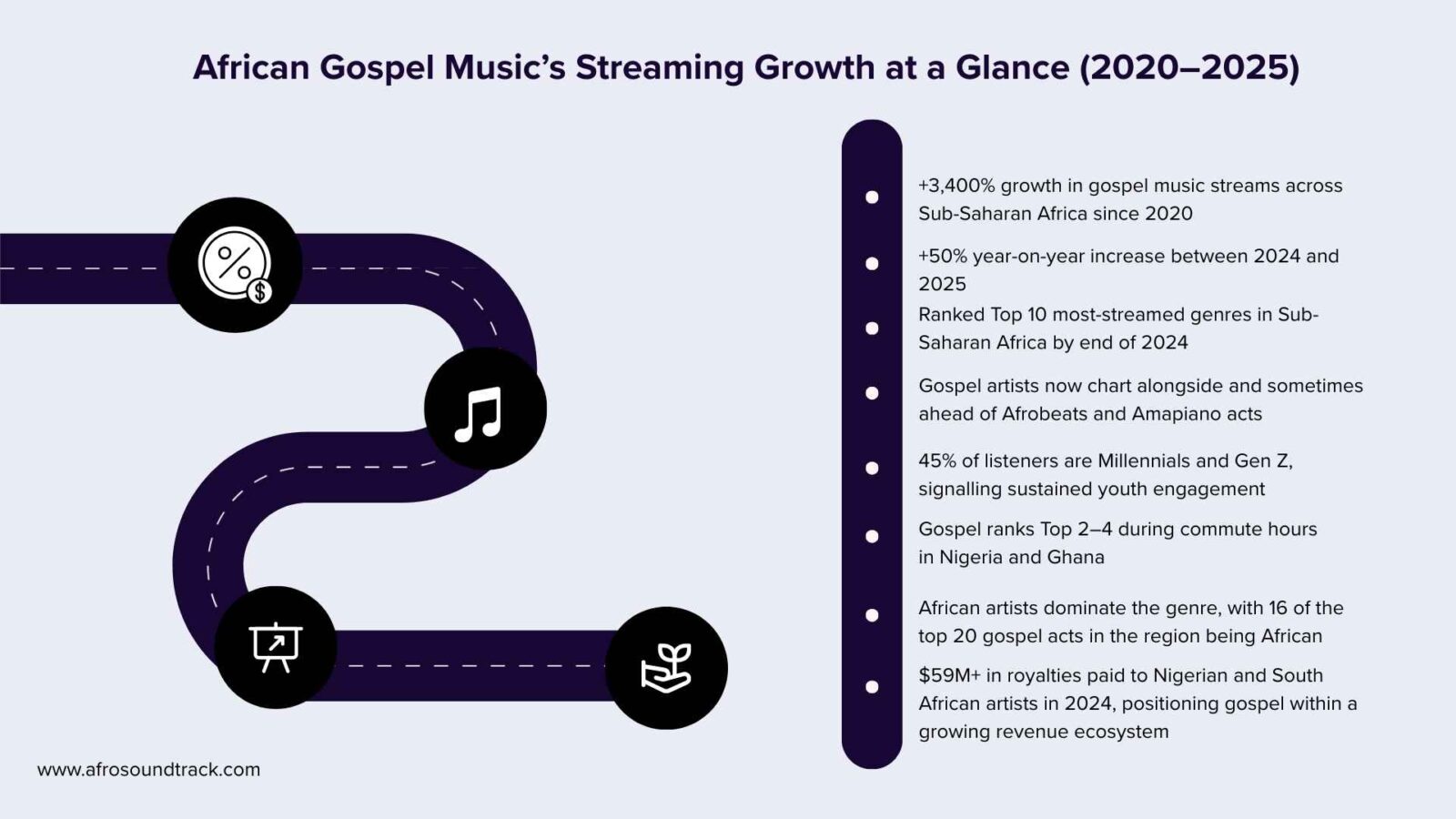
Spotify Wrapped 2025 confirmed the scale of this transformation. Gospel music streams in the region grew by 50 percent year on year and by over 3,400 percent since 2020.
In an industry where most genres grow in single or low double digits, these figures signal a structural shift rather than a short-term surge.
African gospel artists are no longer background voices in a market dominated by Afrobeats and Amapiano. They are chart-topping forces. They are cultural shapers.
They are outperforming Afrobeats heavyweights on major streaming platforms and rewriting the rules of what gospel music can achieve.
This development points to a recalibration within Africa’s streaming economy.
Genres that once sat at the margins are now competing for attention at scale, driven by changes in audience behaviour, platform strategy, and artist professionalism.
Understanding why this growth has accelerated requires looking closely at how listeners are engaging with streaming platforms, how gospel artists are adapting to digital-first careers, and how faith-based music is benefiting from the same infrastructure that once fuelled Afrobeats’ global expansion.
Gospel Music Streaming Growth in Sub-Saharan Africa by the Numbers
The most compelling evidence of gospel music’s rise is not anecdotal. It sits plainly in platform data from 2024 and early 2025, particularly in how gospel artists are performing alongside, and in some cases ahead of, mainstream acts.
In the first quarter of 2025, Nigerian gospel artists Nathaniel Bassey, Mercy Chinwo, and Moses Bliss ranked among the top 20 most-streamed Nigerian acts globally on YouTube Music.
Nathaniel Bassey recorded 52.8 million streams, placing him 13th overall. Mercy Chinwo followed with 46.4 million streams at 17th, while Moses Bliss reached 41.5 million streams, ranking 19th and notably ahead of Afrobeats artist BNXN during the same period.
However, what is truly remarkable is not even their positions on the list but the consistency of listening behind the numbers.
Nathaniel Bassey’s catalogue alone accounts for tens of millions of repeat plays, demonstrating sustained engagement rather than short-term viral spikes.
South Africa shows a similar pattern, with gospel releases competing directly at the top of national charts.
Nontokozo Mkhize’s debut album Lindiwe recorded over one million Spotify streams in its first week, tying with Tyla for the highest first-week debut by a South African female artist.
Her single “Esandleni” went further, becoming the most-streamed solo song by a female artist in a single week on Spotify South Africa, surpassing Adele’s “Easy on Me.”
By the end of the year, Lindiwe had accumulated more than 28 million streams, making it the only gospel album to appear in South Africa’s top 10 most-streamed albums of 2025.
At a regional and global level, the trend holds.
Spotify Wrapped 2024 showed that sixteen of the top 20 most-streamed gospel artists in Sub-Saharan Africa are African. Eight African artists, including Nathaniel Bassey, Moses Bliss, Limoblaze, Joyous Celebration, Dunsin Oyekan, Spirit of Praise, Sunmisola Agbebi, and Mercy Chinwo, ranked among the top 100 most-streamed gospel artists worldwide.
Combined, the data shows that gospel music’s rise in Africa is more than isolated moments of success. They suggest a genre benefiting from high repeat listening, deep catalog engagement, and cross-platform strength.
The question, then, is not whether gospel music is growing, but why its audience is scaling so rapidly across different markets and platforms.
Why Gospel Music Is Growing So Rapidly in Sub-Saharan Africa
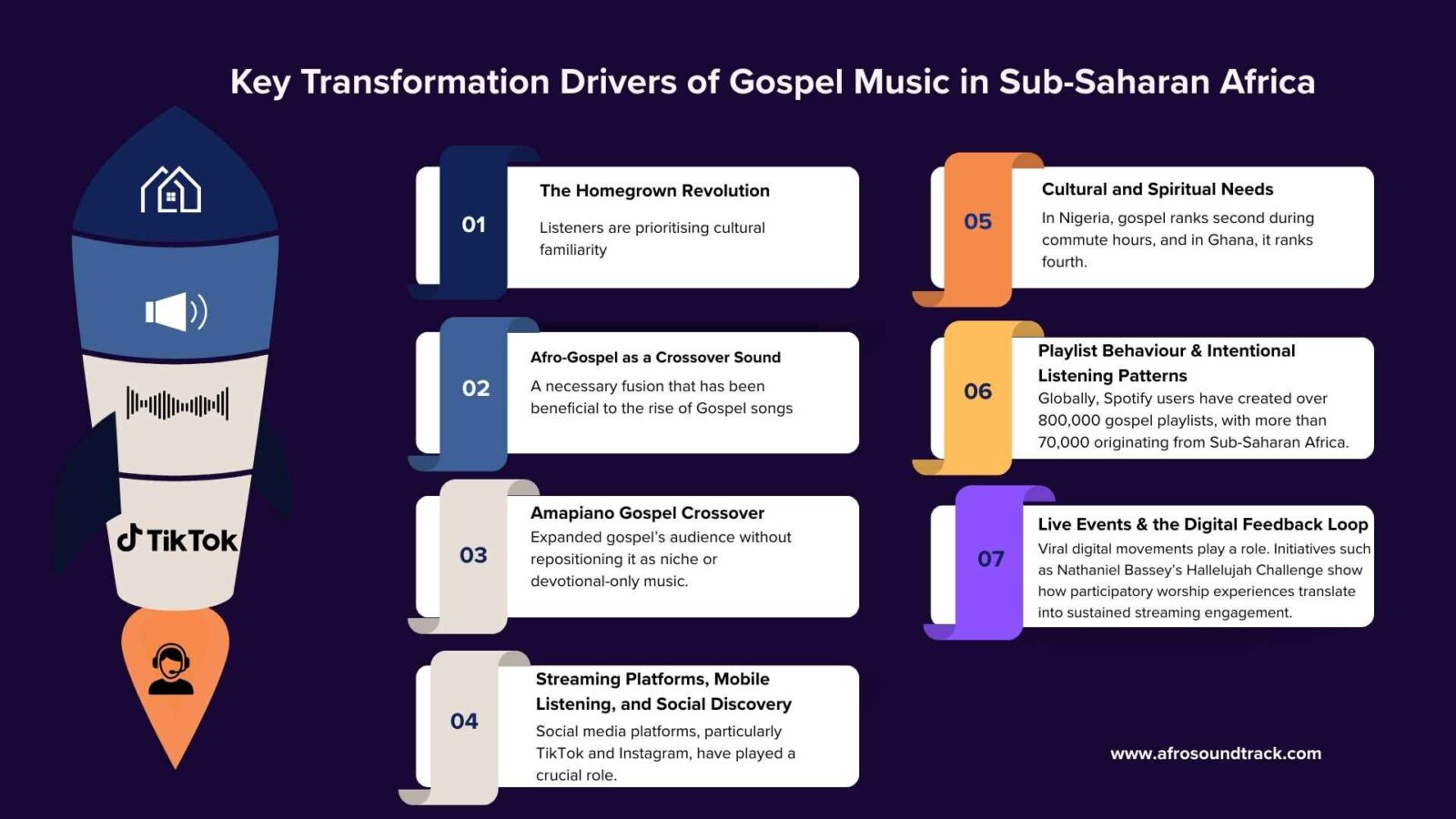
The surge in gospel music streaming across Sub-Saharan Africa is an outcome of several forces converging at the same time, spanning culture, technology, listening behaviour, and sound evolution.
Together, these factors have created conditions where gospel music can scale digitally in ways that were not possible even five years ago:
- The Homegrown Revolution
For much of the past decade, African gospel listeners primarily streamed US-based acts such as Maverick City Music, Elevation Worship, Hillsong, Travis Greene, and CeCe Winans.
While these artists continue to command significant audiences across the continent, recent data points to a clear rebalancing toward African talent rather than a wholesale shift away from international acts.
Phiona Okumu, Spotify’s Head of Music for Sub-Saharan Africa, describes African gospel music as “experiencing a global resurgence that is being driven locally.” That local drive is evident not in isolation, but alongside continued engagement with global worship leaders.
For example, despite his international profile, Chandler Moore’s top listening markets remain African cities, including Lagos, Port Harcourt, and Abuja.
What has changed is listener priority. African listeners are increasingly choosing artists who sing in familiar languages, reflect local worship styles, and embed faith within regional cultural expression, even as they continue to engage with global gospel voices.
- The Rise of Afro-Gospel as a Crossover Sound
One of the most significant developments has been the emergence of what industry insiders call “Afro-gospel,” a fusion of African rhythms, Afrobeats production, and gospel messages.
This sound has proven to be incredibly appealing to younger listeners who want music that reflects both their faith and their cultural heritage.
Songs such as Victor Thompson’s “THIS YEAR (Blessings)” featuring Ehis ’D’ Greatest, alongside Sound of Salem’s “Promise Keeper,” exemplify this trend.
The track became a viral sensation on social media platforms, demonstrating how Afro-gospel can bridge the gap between Western and African worship traditions.
- The Amapiano Gospel Crossover
In South Africa, gospel music has found an unlikely ally in Amapiano, the country’s dominant genre.
Artists like Nontokozo Mkhize have infused gospel messages into piano grooves, creating a unique sound that resonates across multiple audiences.
Mkhize holds the unique distinction of being the only South African gospel artist in 2025 to have an album in the top 10 most-streamed albums on Spotify South Africa.
Her collaborations with Amapiano heavyweights like Kabza De Small and Kelvin Momo have introduced gospel music to listeners who might never have stepped into a church.
This fusion has expanded gospel’s audience without repositioning it as niche or devotional-only music.
- Streaming Platforms, Mobile Listening, and Social Discovery
The explosion of streaming platforms and social media has fundamentally changed how gospel music reaches listeners.
According to Billboard’s 2024 year-end report, gospel music has demonstrated significant growth on streaming platforms, with younger listeners (Millennials and Gen Z) now accounting for 45 percent of gospel listeners, up from 39 percent in 2022.
A good example of this impact is the data from Spotify revealing that nearly 153 million of Kelvin Momo’s streams in 2025 came from mobile consumption alone.
Social media platforms, particularly TikTok and Instagram, have also played a crucial role. The “chant worship” movement, led by artists like Sunmisola Agbebi, Abbey Ojumo and Lawrence Oyor, has has thrived in short-form video environments where stripped-back vocals, immersive arrangements, and emotionally resonant production translate seamlessly.
Behind many of these viral moments are producers shaping the sonic identity of modern African gospel. Production-led records such as Sound of Salem’s “We Will Be Many” and “Joy in Chaos,” produced by Holy Drill, illustrate how contemporary gospel is being built with the same intentionality, texture, and digital-first mindset as mainstream genres.
As both Sound of Salem and Holy Drill are part of the AfroSoundtrack roster, their success highlights the growing role of producers not just as collaborators, but as key architects of gospel’s streaming-era evolution.
- Cultural and Spiritual Needs
Beyond the music itself, the surge in gospel streaming reflects deeper cultural and spiritual needs.
The COVID-19 pandemic, economic challenges, and political uncertainties have driven many people to seek comfort, hope, and meaning through faith-based content.
Spotify Wrapped 2025 provides further insight into how these needs translate into daily listening habits.
In Nigeria, gospel ranks second during commute hours, and in Ghana, it ranks fourth.
Commute listening is usually dominated by energetic mainstream genres, but gospel’s strong presence during these periods shows that listeners are turning to it for motivation, focus, and emotional grounding throughout their day.
- Playlist Behaviour and Intentional Listening Patterns
One of the clearest indicators of gospel music’s deeper integration into daily life is playlist behaviour. Globally, Spotify users have created over 800,000 gospel playlists, with more than 70,000 originating from Sub-Saharan Africa.
Playlist creation signals intent. It shows that listeners are actively organising gospel music around routines, moods, and daily activities.
This is reinforced by Spotify’s Words on Playlists data, where “gospel” ranks among the most-used descriptors in Nigeria, Ghana, Kenya, and South Africa.
Such behaviour points to long-term listening habits rather than passive consumption.
- Live Events and the Digital Feedback Loop
Another major driver of Gospel’s growth is the strong link between live worship experiences and streaming activity.
Large-scale events such as The Experience in Nigeria, Joyous Celebration tours in South Africa, Spirit of Praise concerts, and Moses Bliss’s Grace Encounter events in East Africa create powerful communal moments.
These moments are shared widely on social media, driving discovery and repeat listening on streaming platforms.
This creates a feedback loop. Live events increase online visibility. Online visibility boosts streams. Higher streaming numbers then reinforce artist prominence and event demand.
Viral digital movements also play a role. Initiatives such as Nathaniel Bassey’s Hallelujah Challenge demonstrate how participatory worship experiences translate into sustained streaming engagement.
How Gospel Music’s Recent Growth Compares to Previous Years
The scale of gospel music’s rise becomes clearer when placed against its recent past.
By the end of 2024, the genre had reached ninth place among the most streamed genres in Sub-Saharan Africa.
In the months that followed, that momentum translated into regular chart appearances, with gospel artists showing up alongside, and sometimes ahead of, leading Afrobeats acts across major platforms.
Spotify Wrapped 2025 points to a clear change in chart dominance.
In 2024, international artists made up around 70 percent of the country’s top 10 most streamed acts. By 2025, local artists accounted for the same share.
Within this new balance, Nontokozo Mkhize’s Lindiwe stood out as the only gospel album in the top 10 most-streamed albums, surpassing 28 million streams and competing directly with releases driven by Amapiano and pop audiences.
Overall engagement on Spotify has expanded at the same time.
South African listeners spent more than 1.3 billion hours streaming music on Spotify in 2025, while the top 10 artists were streamed nearly 1.5 billion times, up from 1.1 billion the previous year.
Gospel music’s increasing share of this growth suggests that its rise is not happening in isolation, but within a broader redistribution of listener attention.
And this pattern is not limited to Africa. In the United States, Christian and gospel music recorded an 18.5 percent increase in on-demand audio streams in 2024 compared to 2023, according to Luminate’s 2025 year-end report.
While market dynamics differ, the parallel growth highlights a wider global shift in faith-based music consumption, one that African gospel artists are increasingly influencing rather than merely following.
What remains to be examined is whether this momentum reflects a temporary realignment or a lasting change in how gospel music competes for attention, revenue, and long-term audience loyalty in the streaming economy.
Economic and Industry Implications of Gospel Streaming Growth
While Gospel-specific royalty figures are not fully disclosed, the broader streaming economy provides context.
In 2024, Spotify paid nearly 59 million dollars in royalties to Nigerian and South African artists combined.
Genres with strong streaming growth, including Gospel, are positioned to benefit from this expanding revenue pool.
For artists, songwriters, producers and session musicians, Gospel music’s rise represents real commercial opportunity.
For labels and platforms, it points to a genre with strong repeat listening and long-term audience loyalty.
As gospel music continues to gain ground across streaming platforms, African music creators increasingly need the right structures in place to maximise earnings and long-term value. That’s where we come in.
At AfroSoundtrack, we work with Nigerian and African music creators, including gospel artists, producers, and songwriters, to help them unlock the full potential of their catalog through music publishing administration and sync placement services.
Afro Soundtrack: Powering the Next Wave of Gospel Music in Sub-Saharan Africa
The growth of African gospel music is no longer speculative.
Streaming data from Spotify Wrapped, YouTube Music, and regional platforms confirms sustained audience engagement across Sub-Saharan Africa, with gospel competing directly alongside mainstream genres.
As this momentum continues, the challenge for artists shifts from visibility to value.
Turning streams into long-term income requires strong rights management, publishing administration, and access to global sync opportunities.
At AfroSoundtrack, we understand the business of music and the importance of translating creative success into real financial returns.
We work with African gospel artists, producers, and songwriters to protect their rights, collect royalties, and build sustainable careers within a rapidly expanding digital music economy.
The gospel renaissance is well underway. With the right infrastructure and professional support, African music creators are positioned not only to grow the genre, but to define its future on a global stage.
Sign up for our publishing administration services to start unlocking the full value of your catalog, or click here to learn more.